IMA status
Approved mineral species; first published in 1960. The IMA-approved mineral symbol is Pap.


The Complete Mineral & Gemological Reference
Papagoite is an exceptionally rare blue calcium-copper-aluminum silicate hydroxide with the ideal formula CaCuAlSi₂O₆(OH)₃. Formally described from Ajo, Arizona, in 1960, it is prized for dark-to-cerulean blue crystals, unusual four-membered silicate-ring structure, extreme scarcity, and occurrence as microscopic crystals, secondary vein mineralization and inclusions preserved within quartz.
This reference combines published mineralogy, crystallography, spectroscopy and gemology with Canyonite Laboratory observations of select Papagoite-bearing material from Southern Arizona.
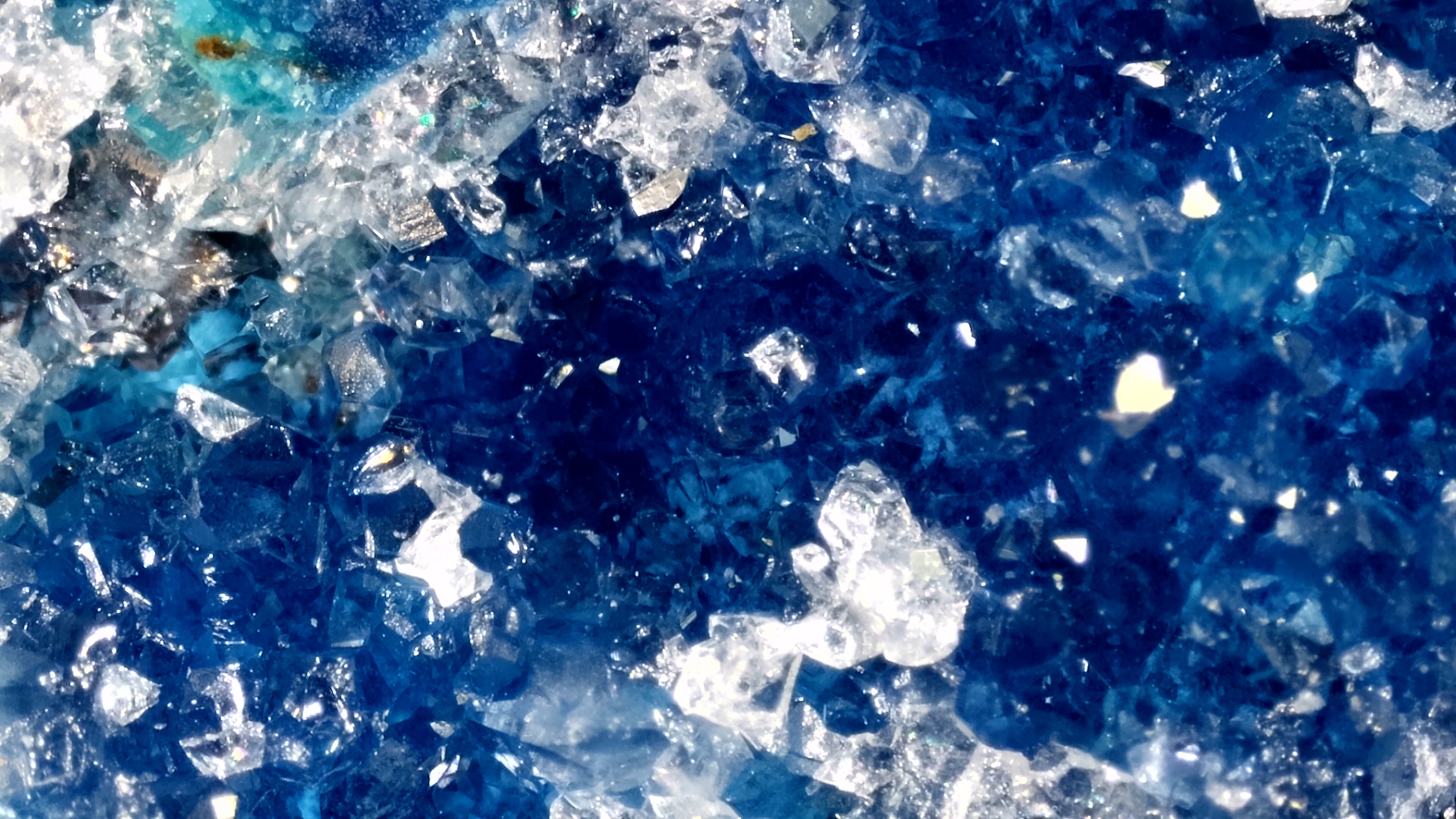
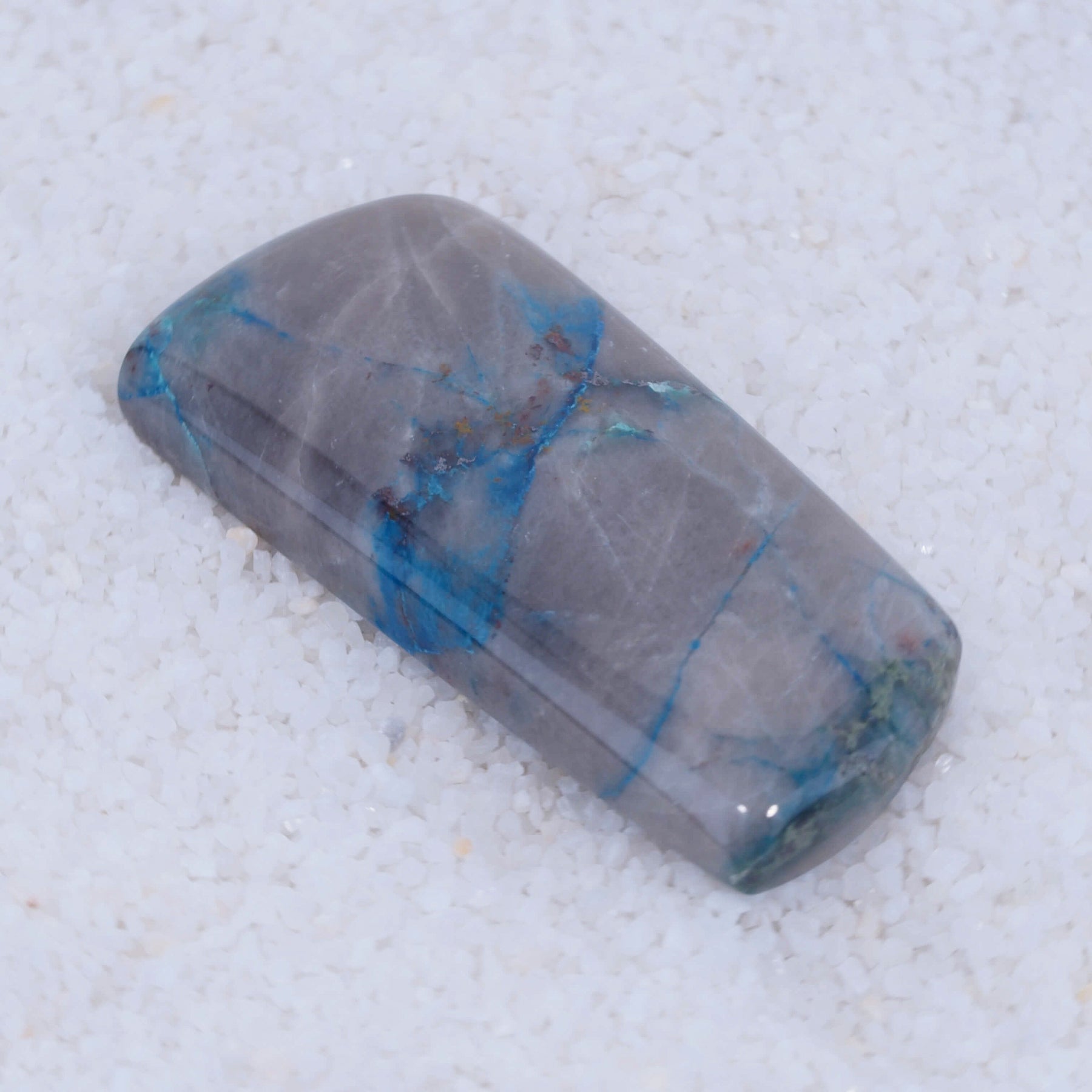
| Mineral | Papagoite |
|---|---|
| Ideal formula | CaCuAlSi₂O₆(OH)₃ |
| Molecular weight | 333.79 g/mol |
| Mineral class | Cyclosilicate; four-membered silicate rings |
| Crystal system | Monoclinic |
| Crystal class | Prismatic, 2/m |
| Space group | C2/m |
| Color | Dark blue crystals; cerulean to lighter blue in massive material |
| Streak | Light blue |
| Hardness | 5–5.5 Mohs for Papagoite; silica-rich composite material may behave closer to quartz |
| Specific gravity | About 3.25 when relatively pure; quartz-rich mixtures can be lower |
| Luster | Vitreous; massive material can appear duller |
| Transparency | Transparent to translucent crystals; massive material may be translucent to opaque |
| Fracture | Brittle |
| Type locality | New Cornelia Mine, Ajo, Pima County, Arizona, USA |
Papagoite is a distinct mineral species, not a trade name for blue copper-bearing rock. Its identity is defined by chemistry and ordered crystal structure. It occurs as tiny flattened crystals, cryptocrystalline or massive aggregates, crusts and coatings, narrow vein material, and inclusions in quartz.
Blue color does not prove Papagoite. Ajoite, Shattuckite, Chrysocolla-related material, Turquoise, Cuprorivaite and other copper minerals can overlap visually. Analytical evidence is much stronger than color alone.
Papagoite entered the scientific literature in 1960, when C. Osborne Hutton and Angelina C. Vlisidis published Papagoite, a New Copper-Bearing Mineral from Ajo, Arizona in American Mineralogist. The New Cornelia Mine at Ajo became its type locality.
The name derives from the historical term “Papago.” Modern sources connect the name to O’odham peoples of the Ajo region, including the Hia C-eḍ O’odham, historically called the Sand Papago. The formally approved mineral name remains Papagoite while modern treatment of its etymology should acknowledge that historical context.
The New Cornelia deposit is also the type locality for Ajoite, another rare blue-green copper silicate that is frequently discussed with Papagoite.
Approved mineral species; first published in 1960. The IMA-approved mineral symbol is Pap.
9.CE.05 — cyclosilicates containing four-membered single silicate rings.
60.01.04.01 — cyclosilicates with four-membered rings.
Monoclinic, prismatic crystal class 2/m, space group C2/m.
Papagoite belongs structurally among ring silicates rather than the framework silicates that include quartz. A specimen can therefore contain Papagoite inside quartz while the two remain completely different mineral species.
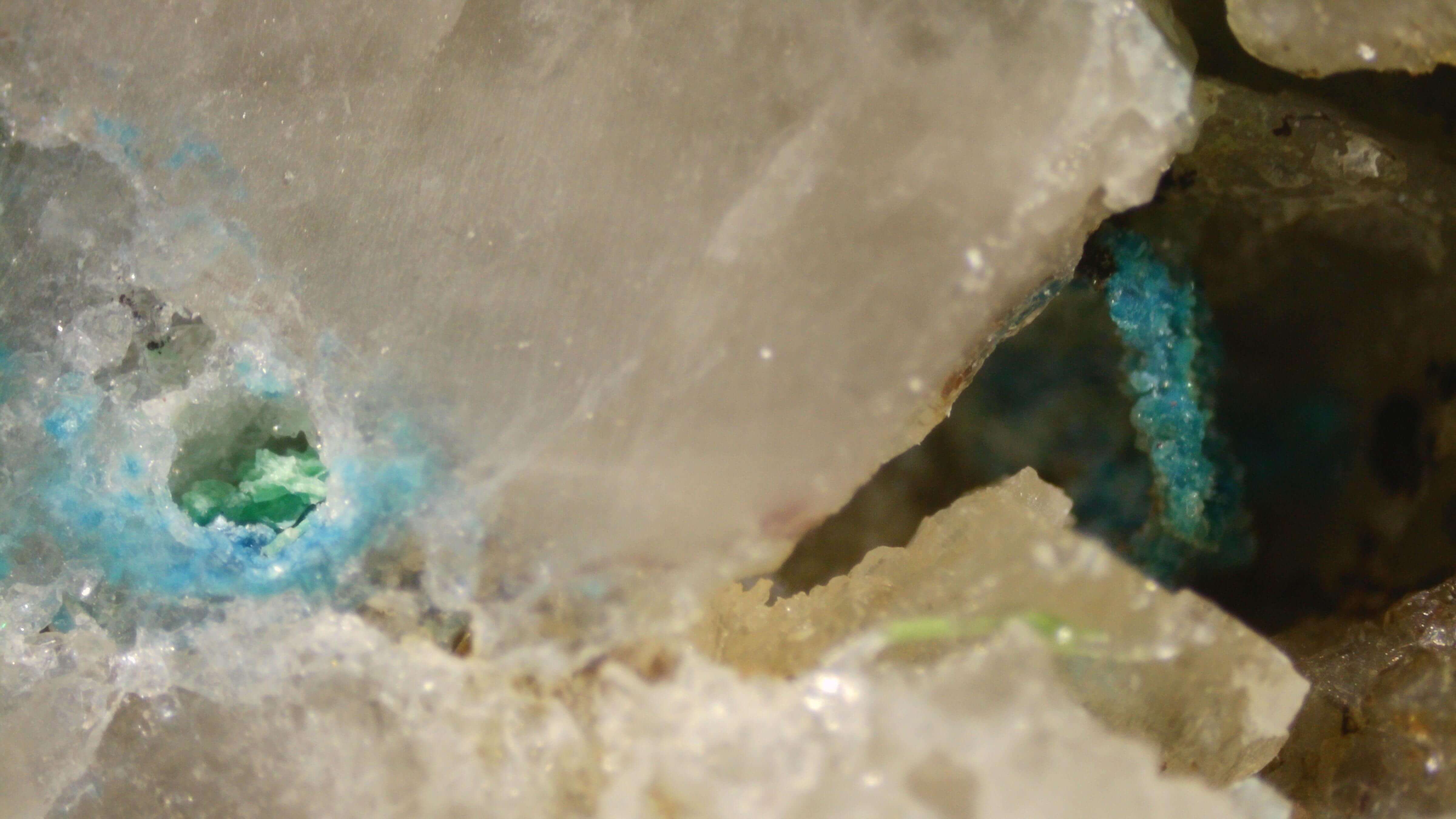
The ideal formula corresponds to calcium, copper, aluminum, silicon, oxygen and hydroxyl. Webmineral calculates a molecular weight of 333.79 g/mol and approximate elemental mass fractions of Ca 12.01%, Cu 19.04%, Al 8.08%, Si 16.83%, H 0.91% and O 43.14%.
Copper is fundamental to both the structure and the blue color. Natural material can include minor substitutions, microscopic intergrowths and adjacent phases, so detecting the correct elements alone does not prove Papagoite.
Groat and Hawthorne’s 1987 refinement showed strongly distorted Cu²⁺ coordination associated with Jahn–Teller behavior. Copper and aluminum polyhedra are linked with Si₄O₁₂ four-membered rings, creating the structural framework that gives Papagoite its distinct diffraction and vibrational signatures.
Pure Papagoite is about 5–5.5 Mohs. IGS notes heavily silicified composite material can approach quartz-like hardness near 7.
About 3.25 for relatively pure Papagoite. Quartz-rich composite material may measure substantially lower.
Cleavage occurs on {100}; descriptions range from distinct to imperfect depending on material. Fracture is brittle.
Light-blue streak; vitreous luster on crystals, becoming duller in some massive aggregates.
IGS reports absorption features centered near 4480, 5150 and 5550 Å (approximately 448, 515 and 555 nm), consistent with selective absorption contributing to Papagoite’s strong blue appearance.
Papagoite is a secondary mineral. At the Ajo type locality it occurs on slip surfaces and in narrow veinlets within altered granodiorite porphyry. Secondary minerals form after earlier rock and ore minerals are modified by oxidation, groundwater, dissolution, transport, replacement and reprecipitation.
Copper is concentrated during an earlier mineralizing event.
Oxygen-bearing fluids react with primary minerals and wall rock.
Copper and other dissolved components migrate through fractures and altered zones.
pH, redox state, silica activity and wall-rock reactions control secondary-mineral stability.
A narrow combination of Cu, Ca, Al, Si and hydroxyl-bearing conditions permits Papagoite to precipitate.
Quartz or chalcedony can encapsulate earlier mineralization and preserve textural relationships.
No single universal temperature, pressure, pH or oxidation potential has been established for all natural Papagoite. Its extreme scarcity despite widespread copper, silica, calcium and aluminum suggests a comparatively narrow stability field.
Quartz-hosted inclusions from South Africa demonstrate how later silica can physically isolate Papagoite. Encapsulation can preserve morphology, color, boundaries and paragenetic relationships that might otherwise be altered or destroyed.

Papagoite is historically documented from only a small number of principal occurrences. Database locality counts can differ because mines, shafts, dumps and districts may be recorded separately.
The type locality. Papagoite occurs as secondary mineralization in altered granodiorite porphyry, with classic associates including Ajoite, Shattuckite, Aurichalcite and Barite.
Famous for quartz crystals containing Papagoite, Ajoite and, in some specimens, native copper and other inclusions. The quartz-hosted material is among the best-known collector expressions of the species.
A recognized occurrence notable for crystalline to microcrystalline Papagoite specimens.
Papagoite has also been reported from the Bankov mineralized area, broadening the geological settings in which the species is known.
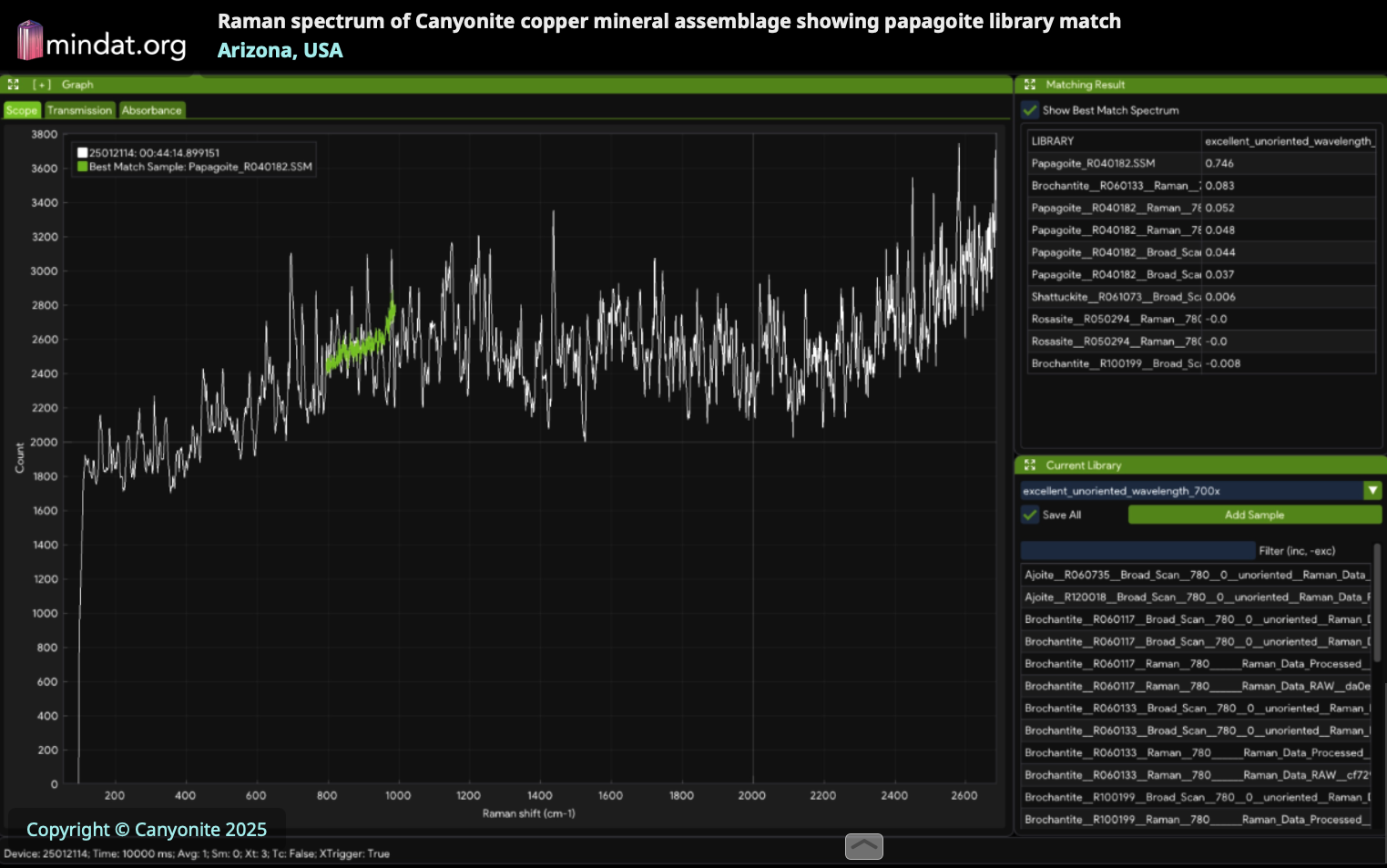
Select representative Canyonite material from Southern Arizona has produced Raman evidence supporting Papagoite within a variable silica-hosted copper-mineral assemblage. Because formal database recognition and peer-reviewed locality publication are separate steps, Canyonite documentation treats this as an analytically documented occurrence in ongoing study rather than attempting to redefine Papagoite or its type locality.
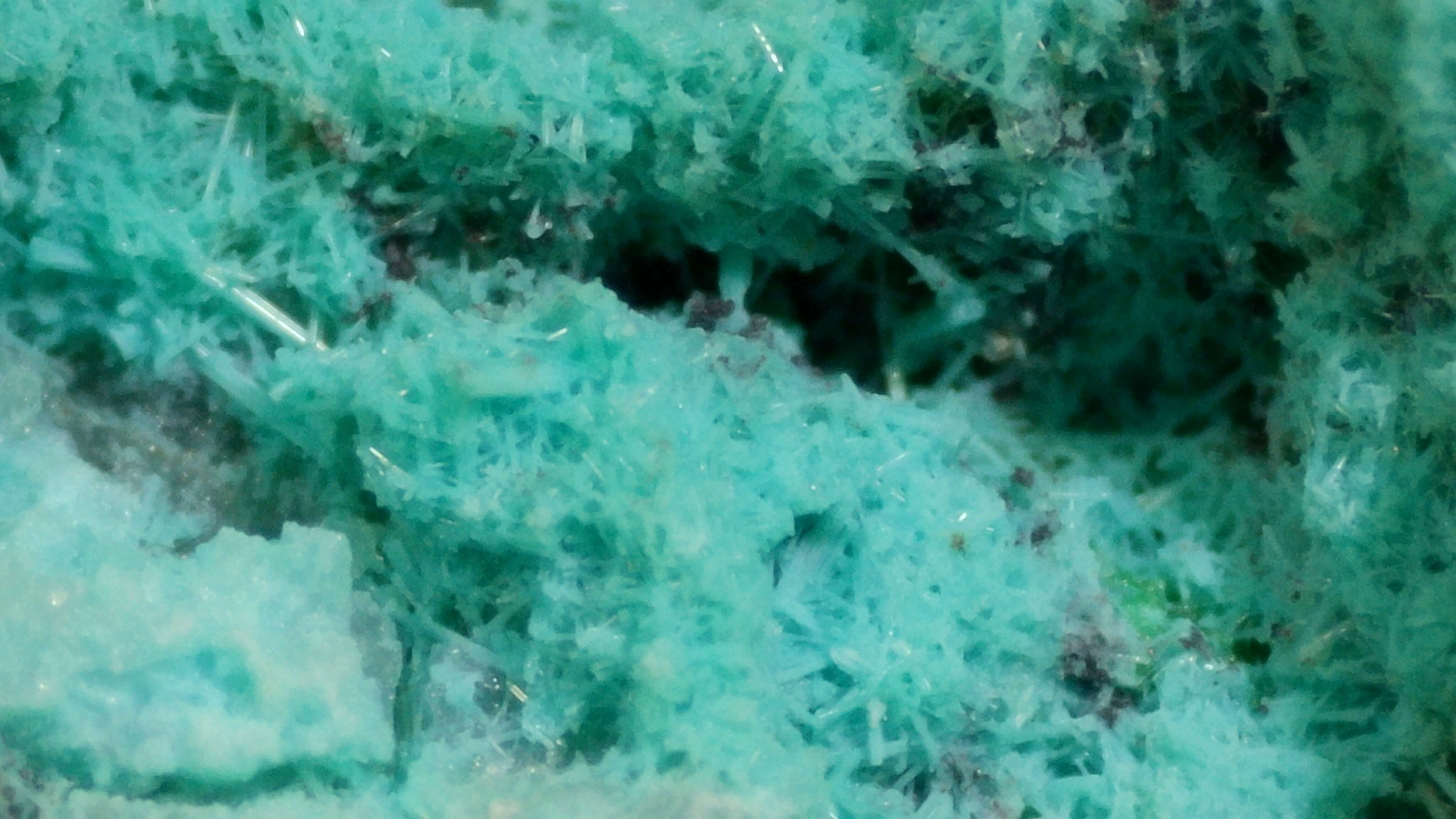
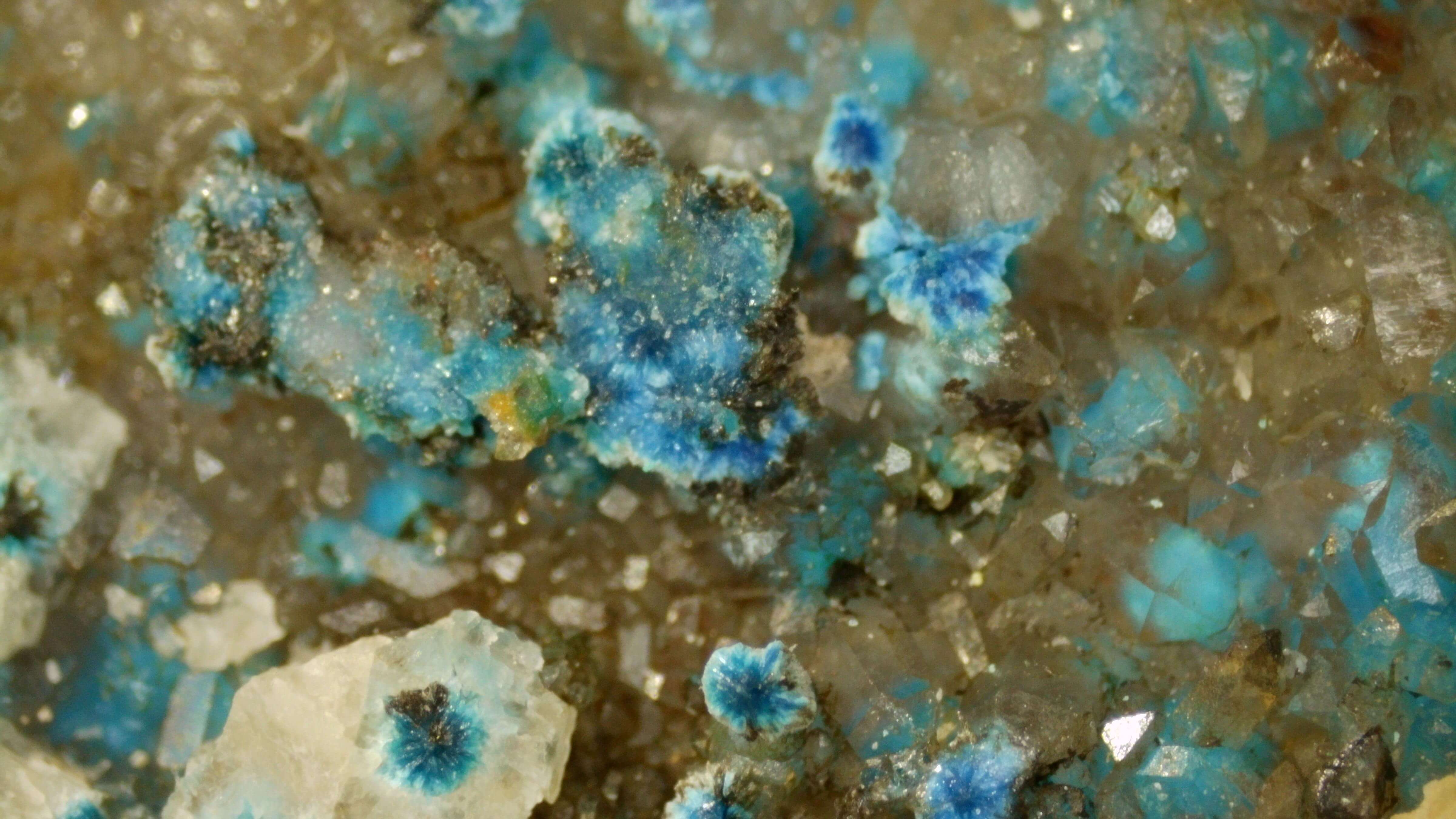
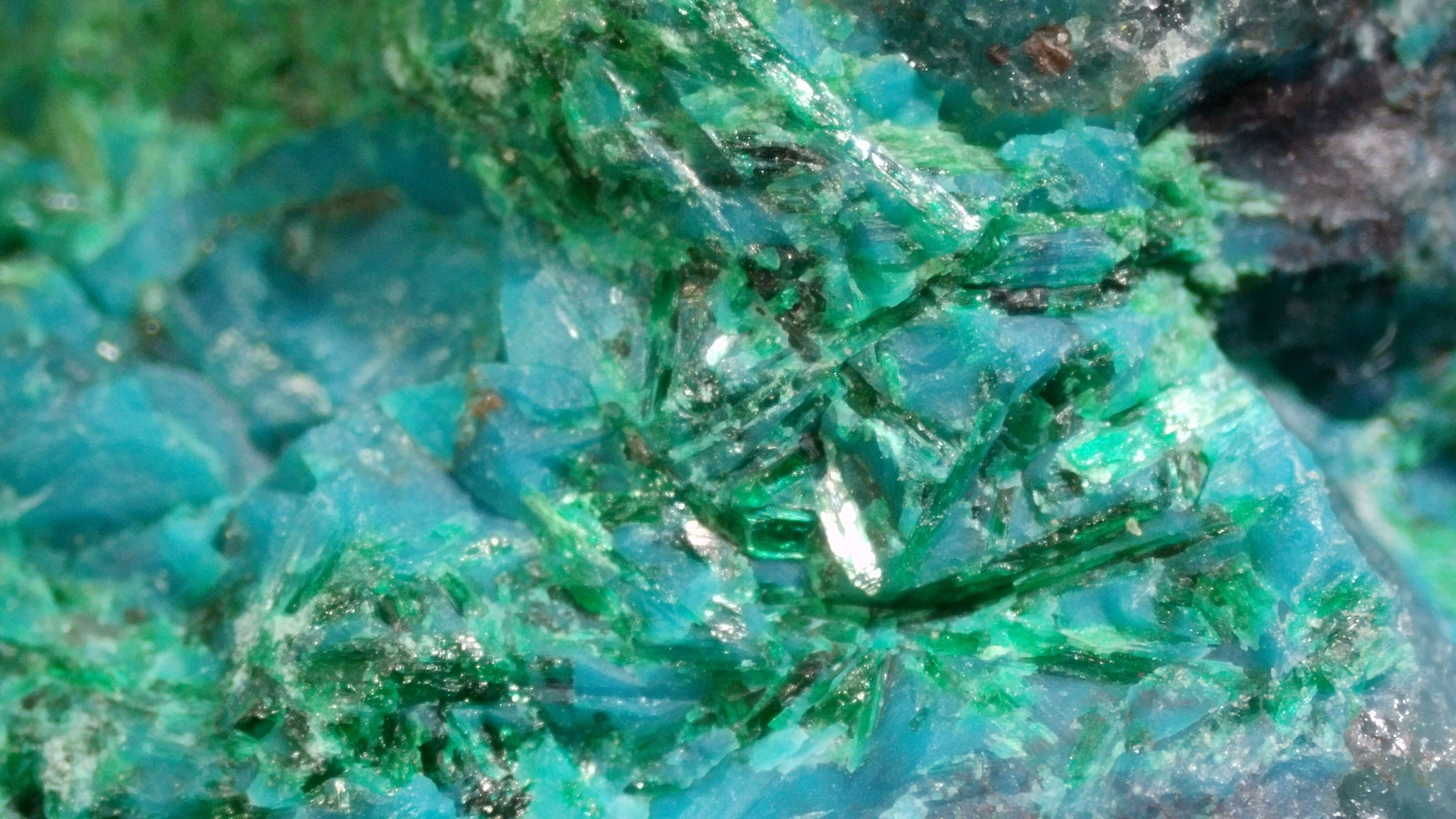
A chemically and structurally distinct copper-aluminum silicate. It can coexist with Papagoite and is famously included in Messina quartz.
An intense blue copper silicate that can closely resemble Papagoite in veins, aggregates and polished material.
Far more widespread and capable of producing overlapping blue, cyan, turquoise and green colors.
A different calcium-copper silicate. Modern Messina research demonstrates that similarly colored blue phases may occur in the same district.
Other reported associates include Aurichalcite and Barite at Ajo, and quartz, Ajoite and native copper in South Africa. Under magnification, massive Papagoite/quartz material can show an interlocking texture and may contain minute metallic copper inclusions.
Compares vibrational spectra from a focused spot with validated reference spectra and is especially useful for microscopic inclusions.
Identifies crystalline phases through diffraction produced by their ordered atomic structures.
Electron-microprobe or related methods can test whether chemistry at microscopic scale is consistent with Papagoite.
Habit, host mineral, locality, growth relationships and neighboring phases provide critical supporting evidence.
Papagoite has a light-blue streak, but streak testing is destructive. It should never be performed on a finished gemstone or valuable specimen and is a poor choice when non-destructive analytical methods are available.
An analysis applies to the spot analyzed. One Papagoite-positive point does not automatically identify every blue region in a heterogeneous specimen. Multiple spots, mapping or complementary methods may be required.
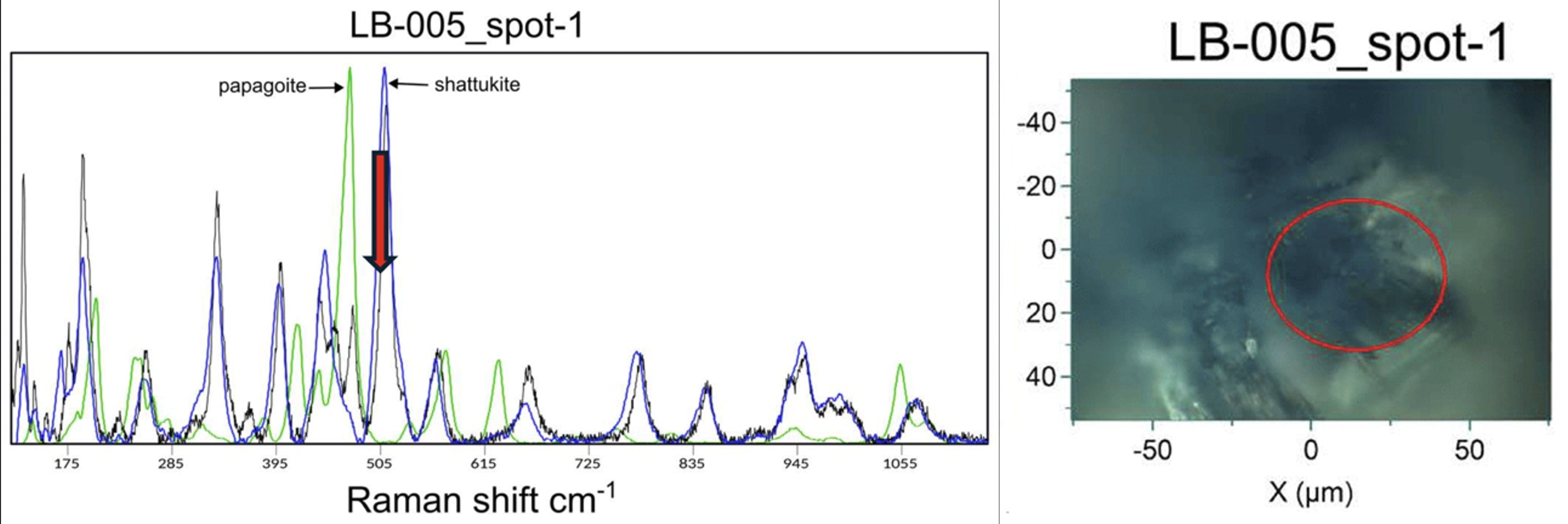
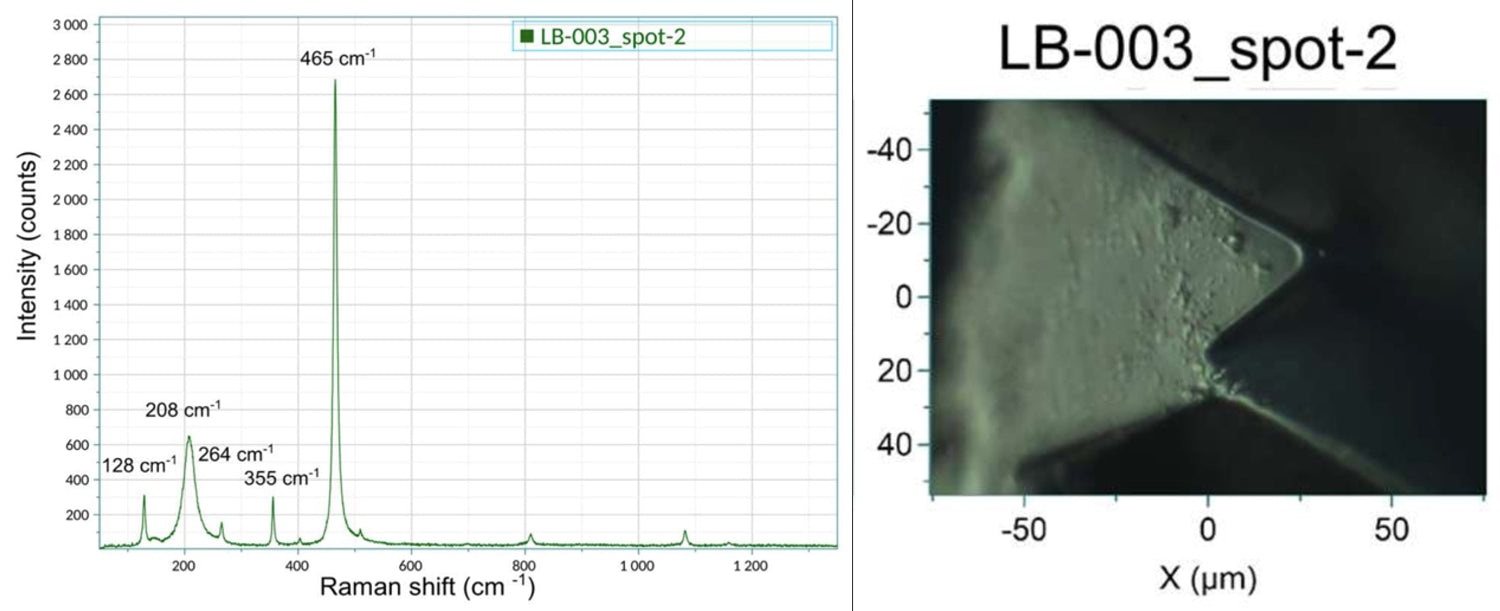
Raman spectroscopy measures shifts in laser light caused by crystal vibrations. A dedicated study by Frost and Xi reported important Papagoite bands near 1053 cm⁻¹, around 630 cm⁻¹ with a shoulder near 644 cm⁻¹, lower-wavenumber features near 419 and 460 cm⁻¹, and OH-region bands near 3545 and 3573 cm⁻¹.
These are not a one-peak checklist. Orientation, fluorescence, grain size, mixed phases, laser wavelength, calibration and matrix effects can shift or obscure spectral features.
Webmineral lists strong powder-diffraction d-spacings near 2.874 Å, 2.204 Å and 4.29 Å. XRD is particularly powerful when sufficient crystalline material is available, while Raman can be advantageous for tiny targeted areas in valuable specimens.
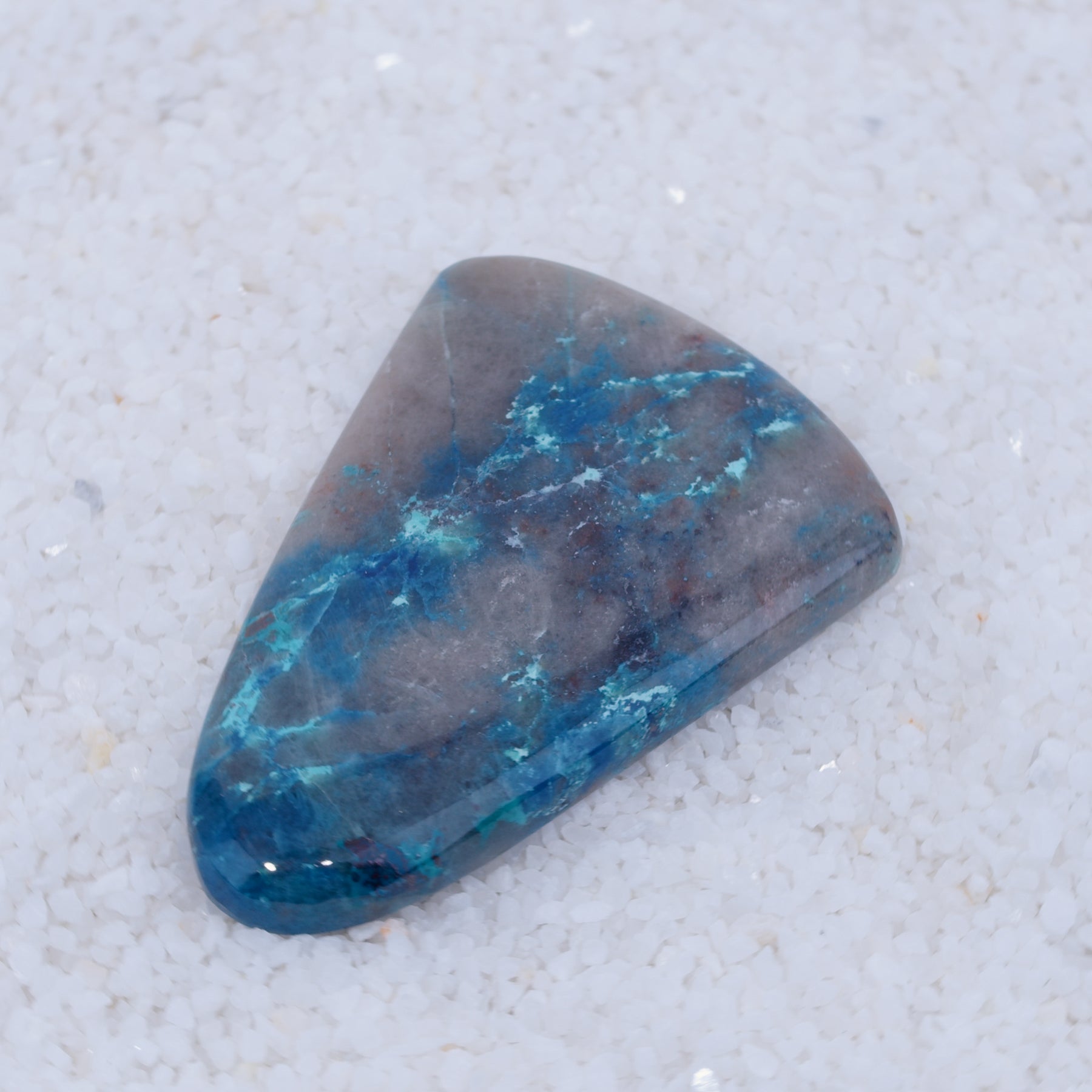
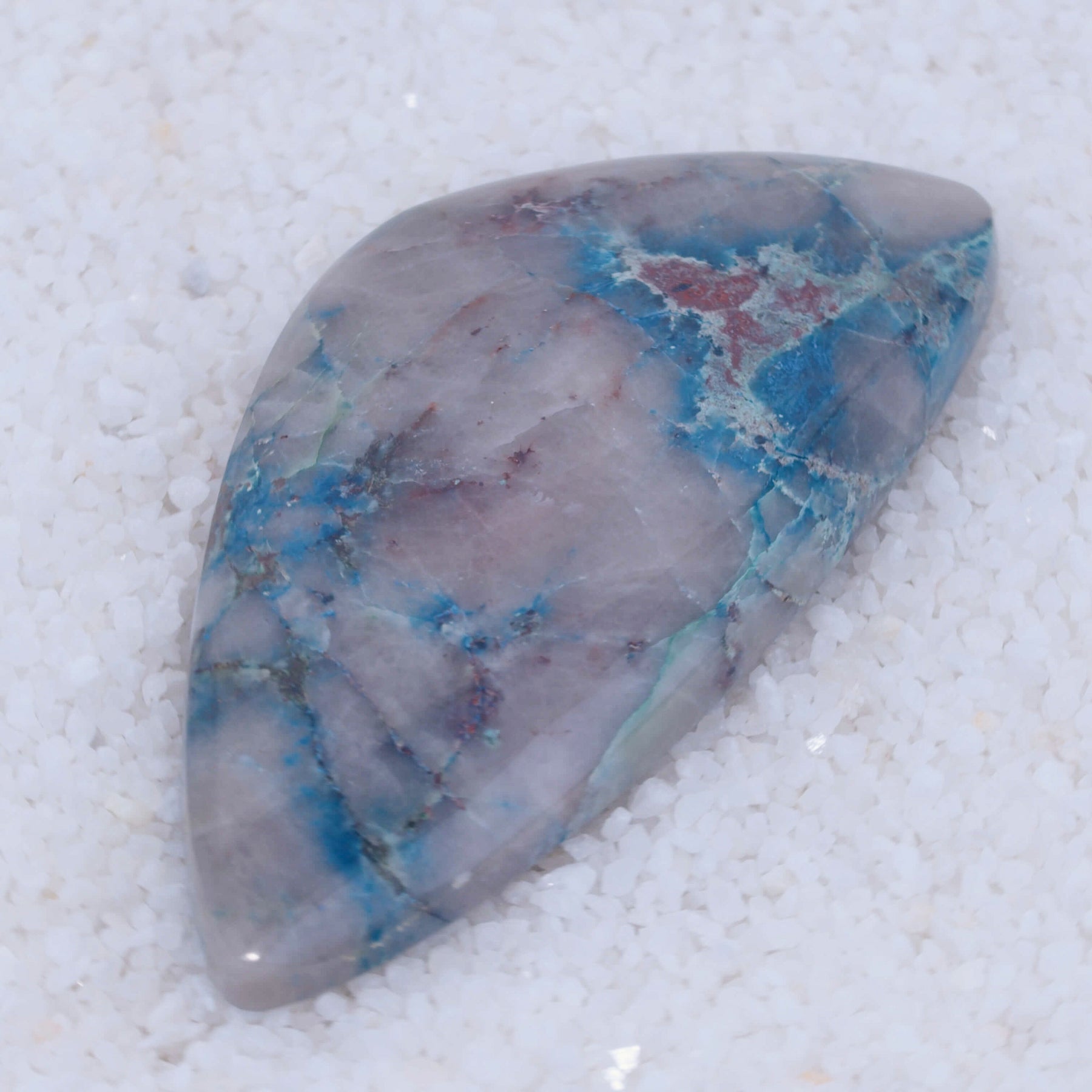
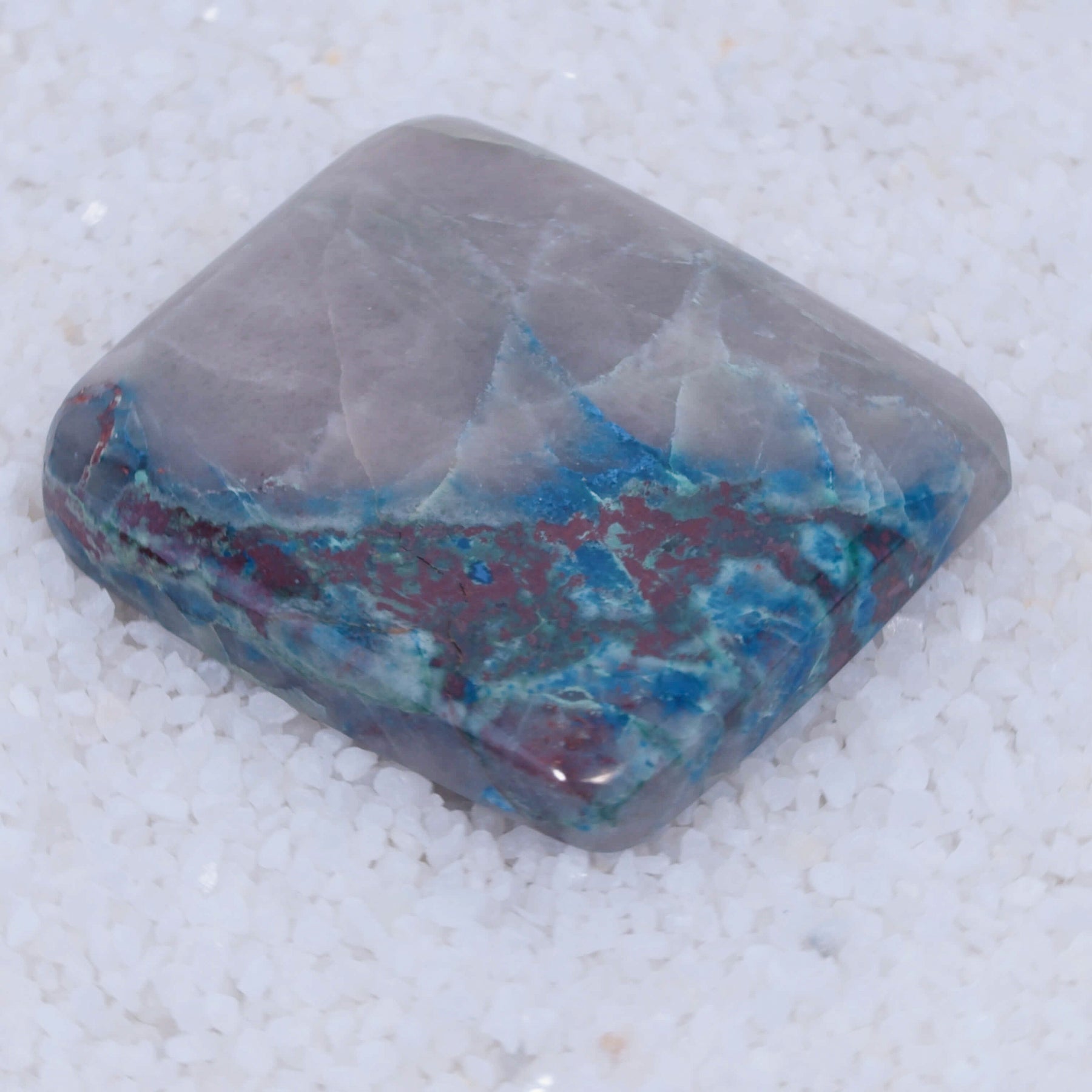
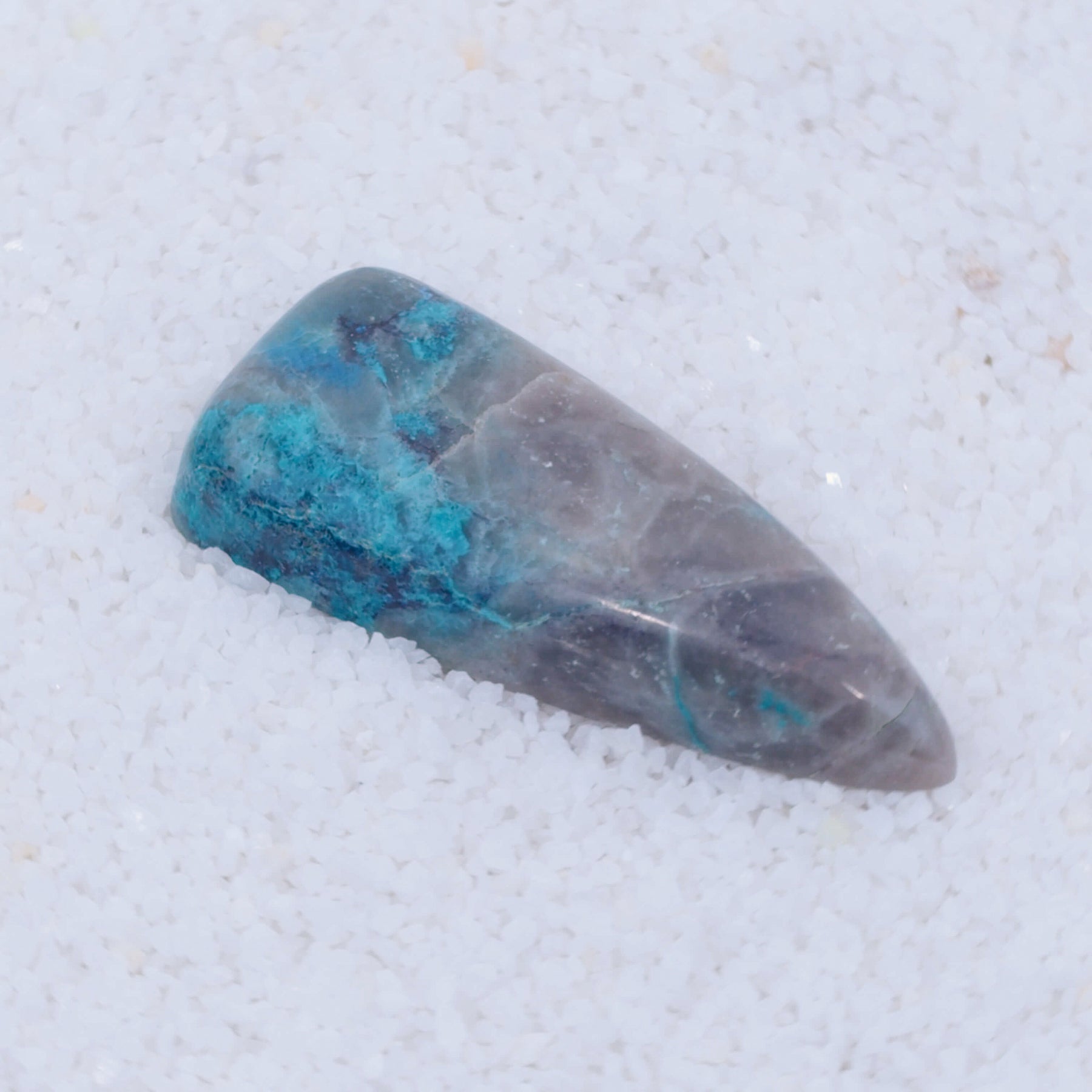
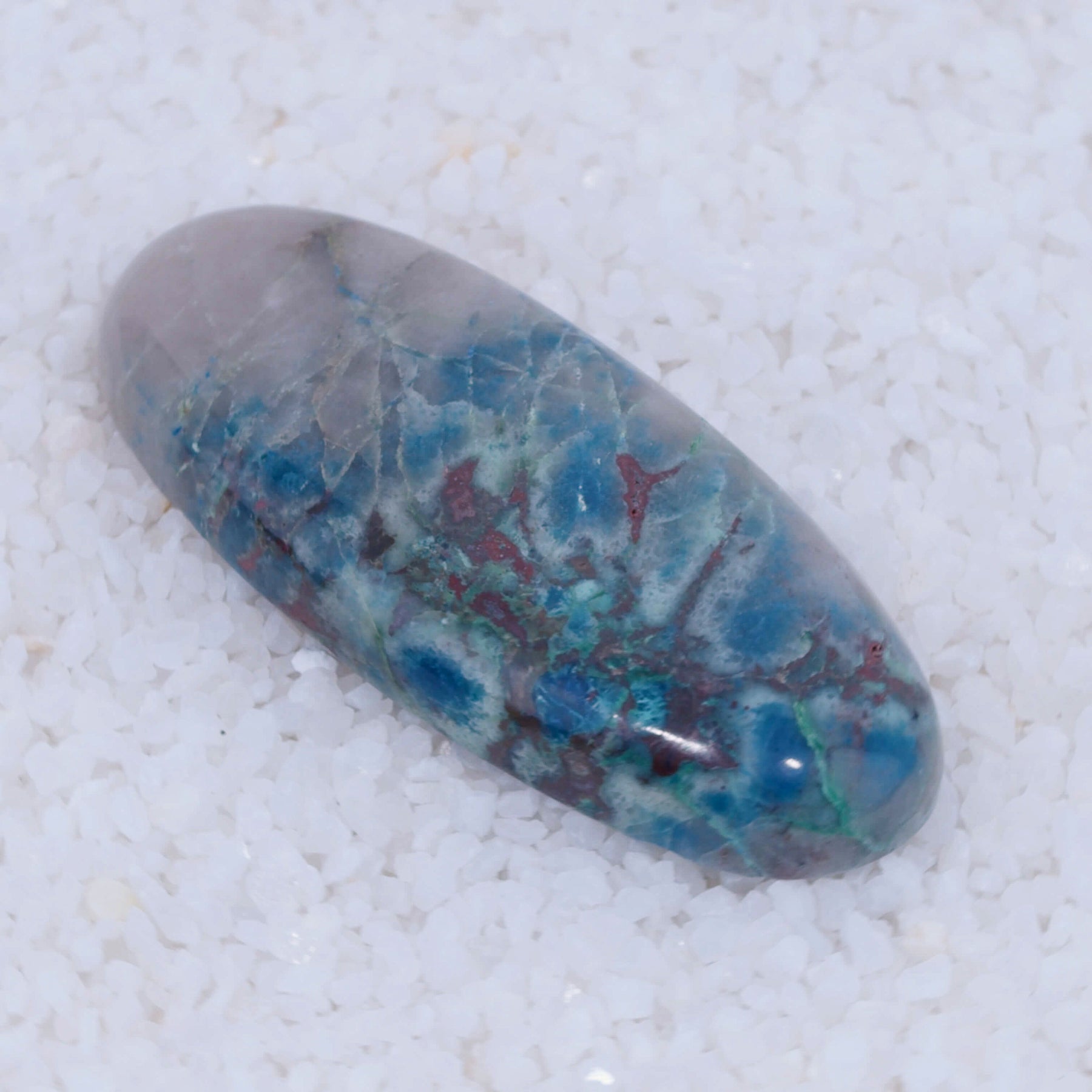
Individual Papagoite crystals are generally too small for conventional faceting. The important gemological form is massive or included material associated with quartz or chalcedony. IGS notes that Papagoite/quartz material can take a high polish and can be cut into cabochons several inches long.
These descriptions are more accurate than implying that an entire large cabochon is a solid single crystal of Papagoite. In composite material, durability, density and polishing behavior may be controlled largely by the quartz-family host.
For delicate microcrystalline specimens, IGS recommends a soft brush, mild detergent and warm water. Avoid destructive streak testing, harsh chemicals and unnecessary mechanical shock. More durable cabochons dominated by quartz or chalcedony can tolerate normal careful gemstone handling, but fracture-rich composite material should still be treated conservatively.
IGS reports no known synthetic or lab-created Papagoite in the gem trade. It also reports no established routine treatment for Papagoite itself. That does not mean every commercial object containing Papagoite is untreated: quartz-rich or composite host material could theoretically be stabilized, filled, dyed, coated or otherwise altered, so treatment disclosure remains a separate issue from mineral identity.
There is no universal Papagoite price per carat. Online asking prices vary widely, and rare-mineral value depends on factors including analytical certainty, locality, provenance, crystal development, abundance, color, size, host transparency, associated species, aesthetics, condition and historical significance. A microscopic type-locality specimen and a large polished Papagoite-bearing quartz or chalcedony gemstone are fundamentally different collector objects.
For high-value material, analytical documentation and provenance should carry more weight than an unsupported rare-mineral label.
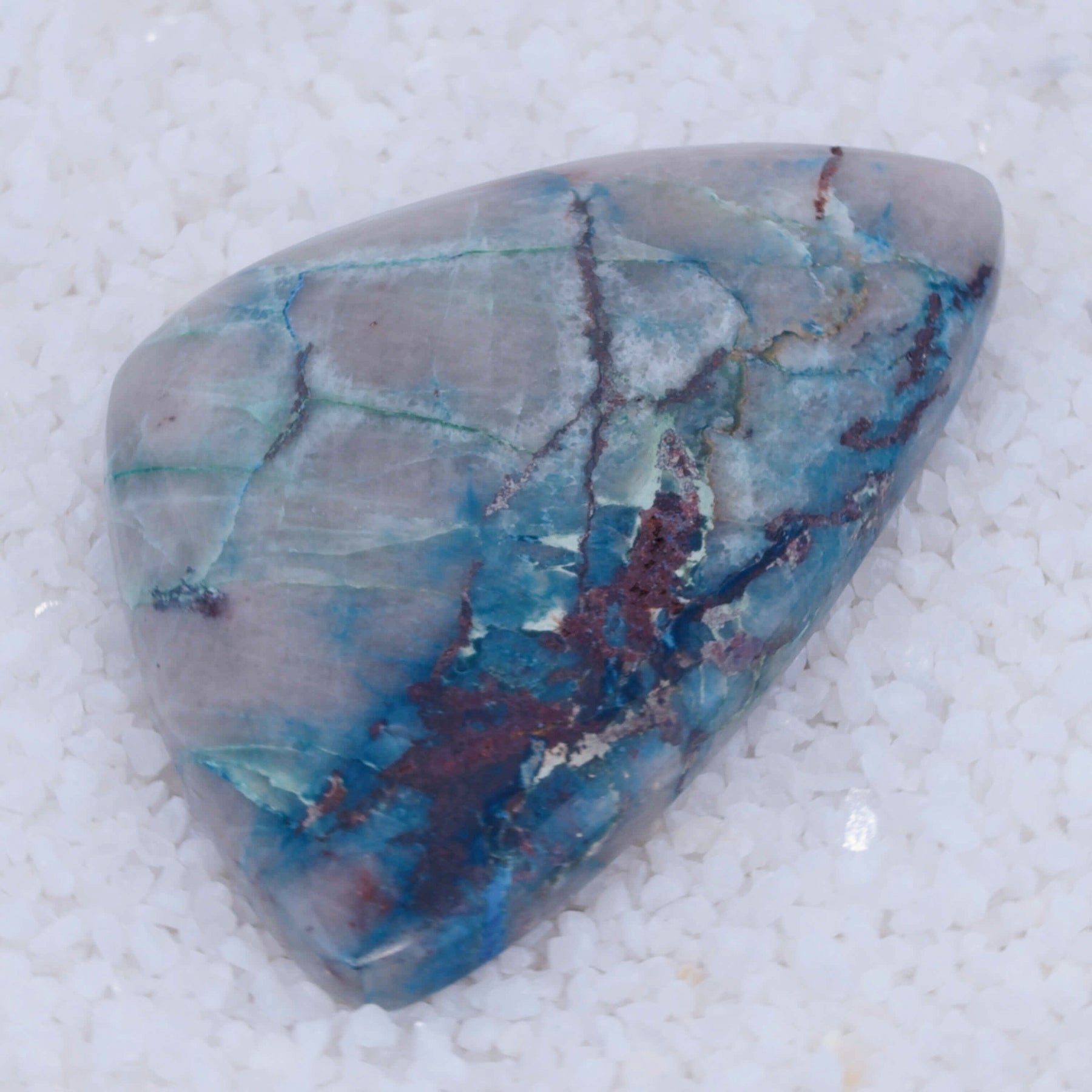
Papagoite has been analytically identified in select representative Canyonite material from Southern Arizona.
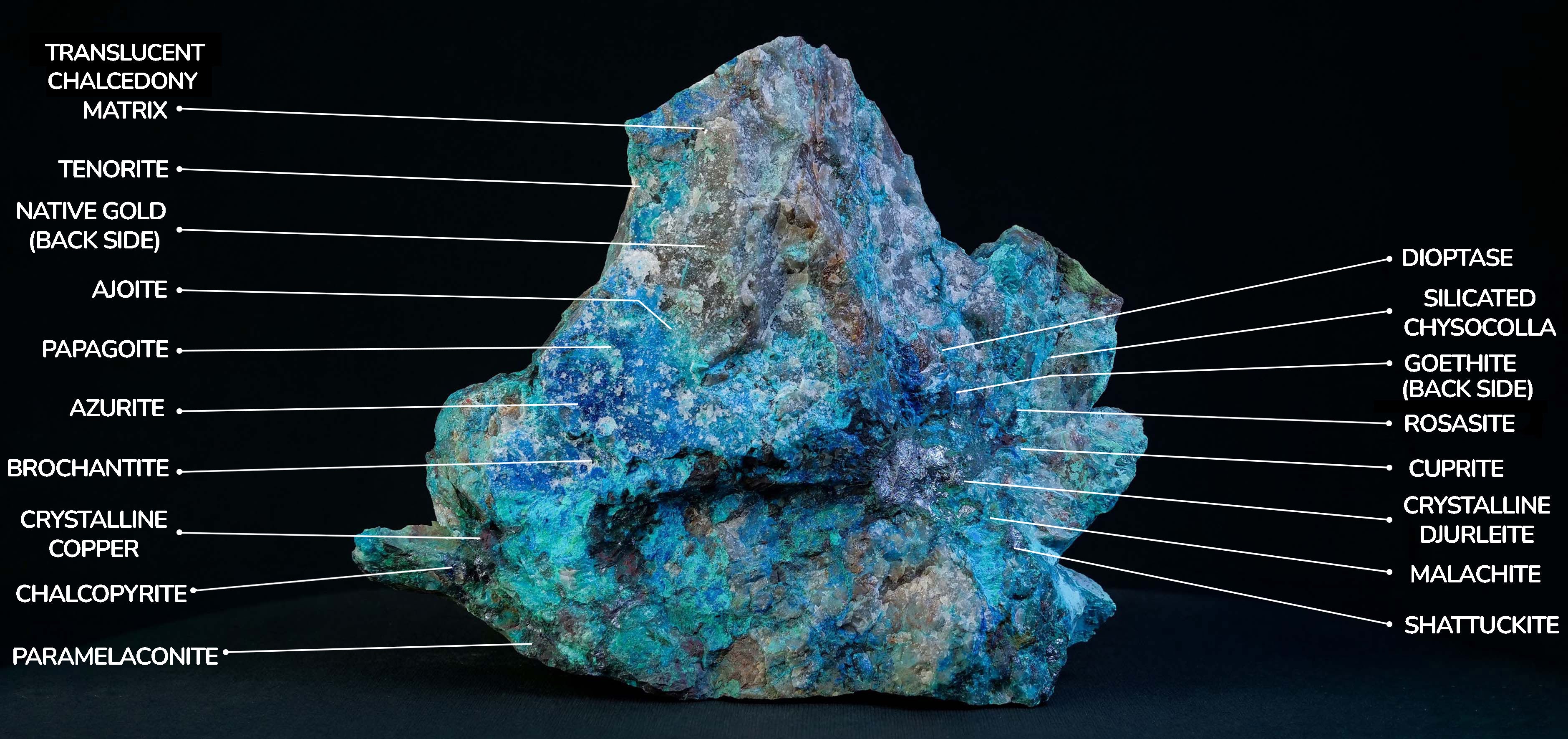
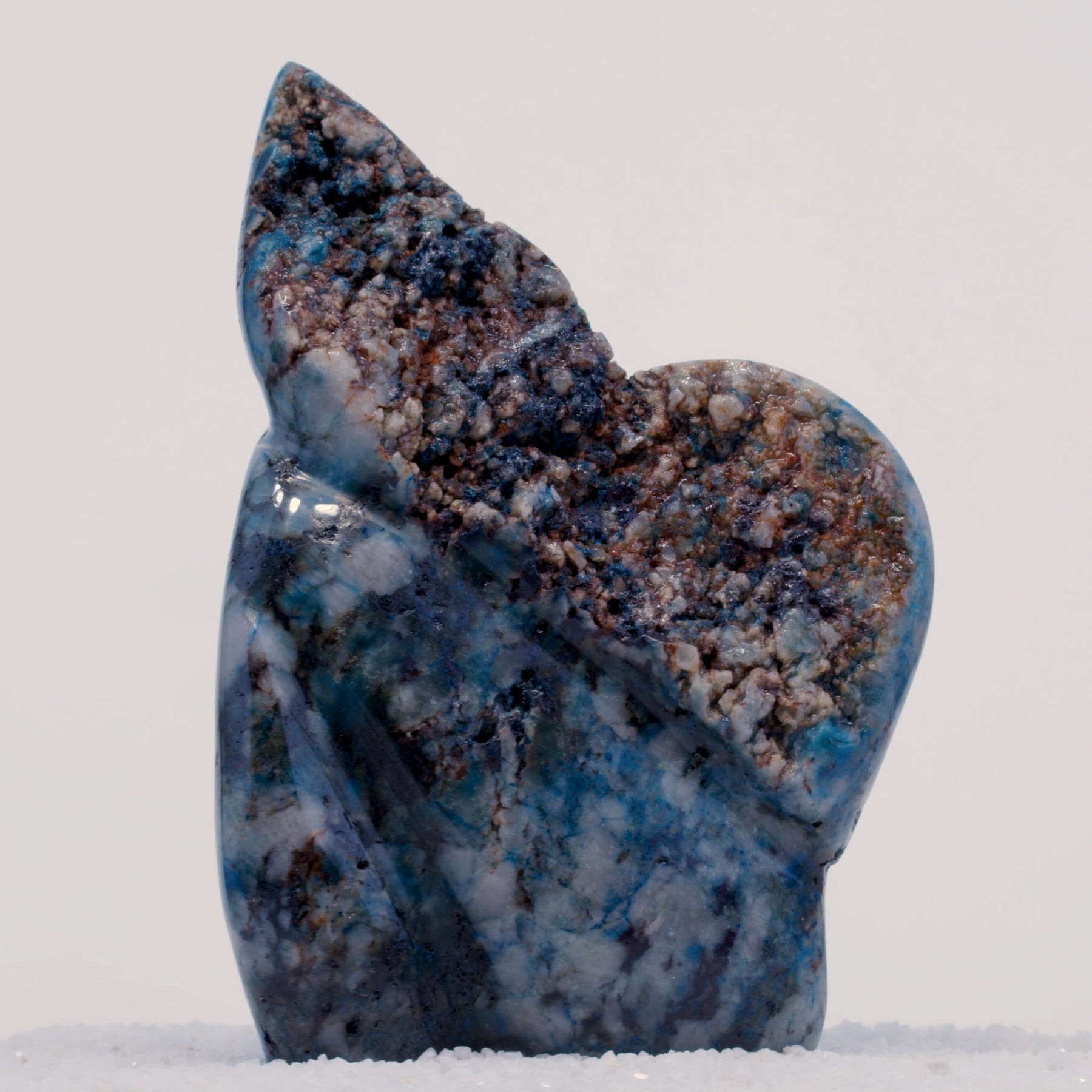
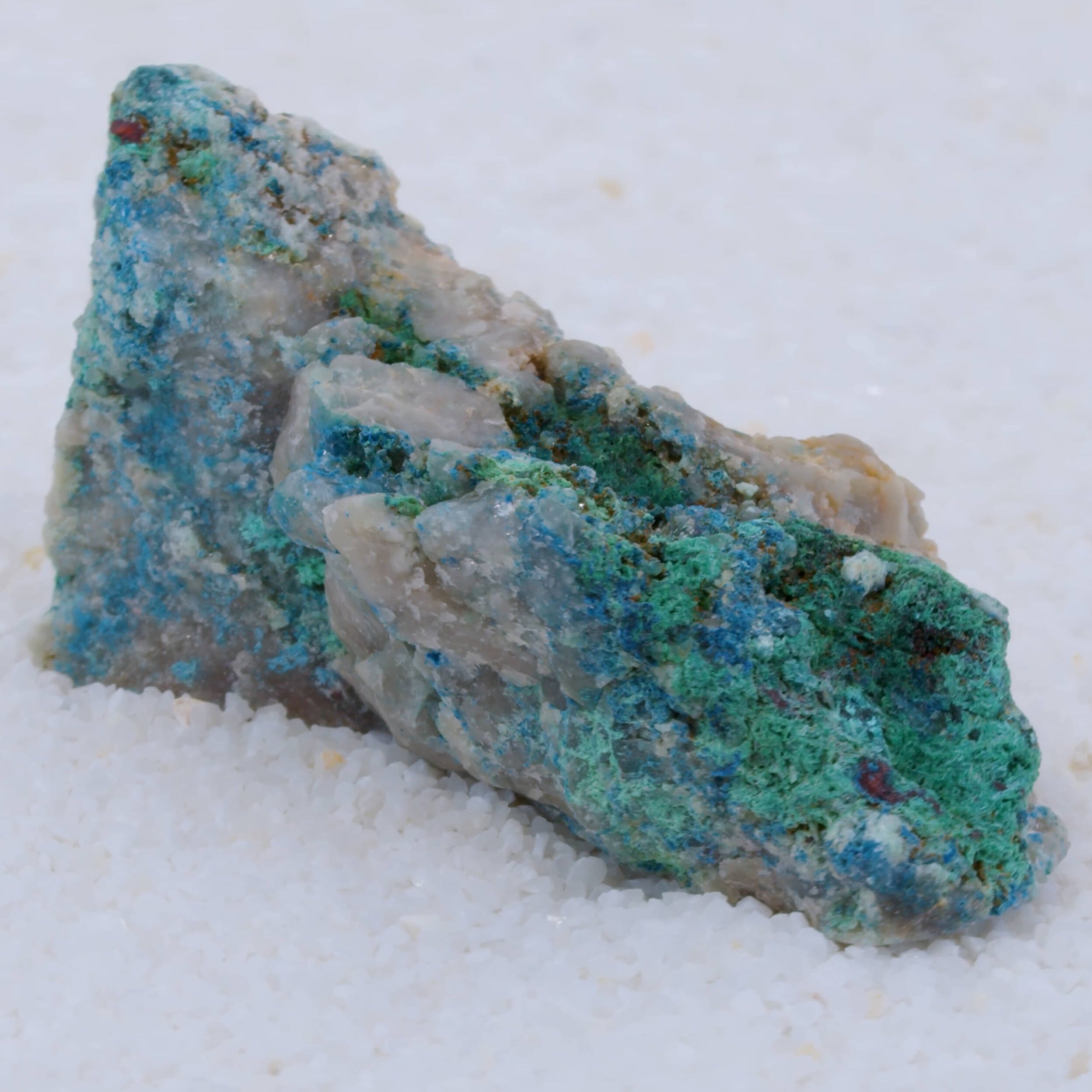
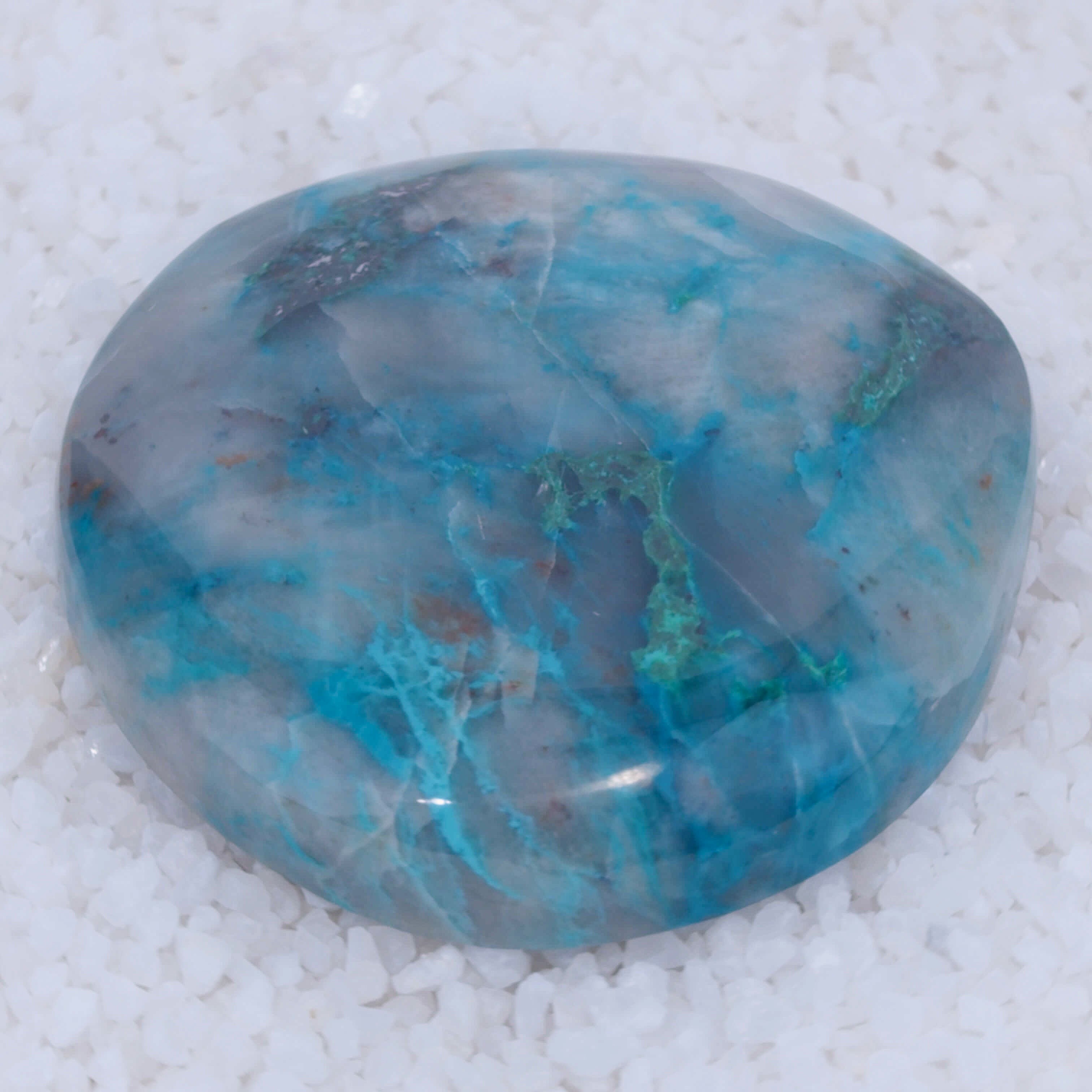
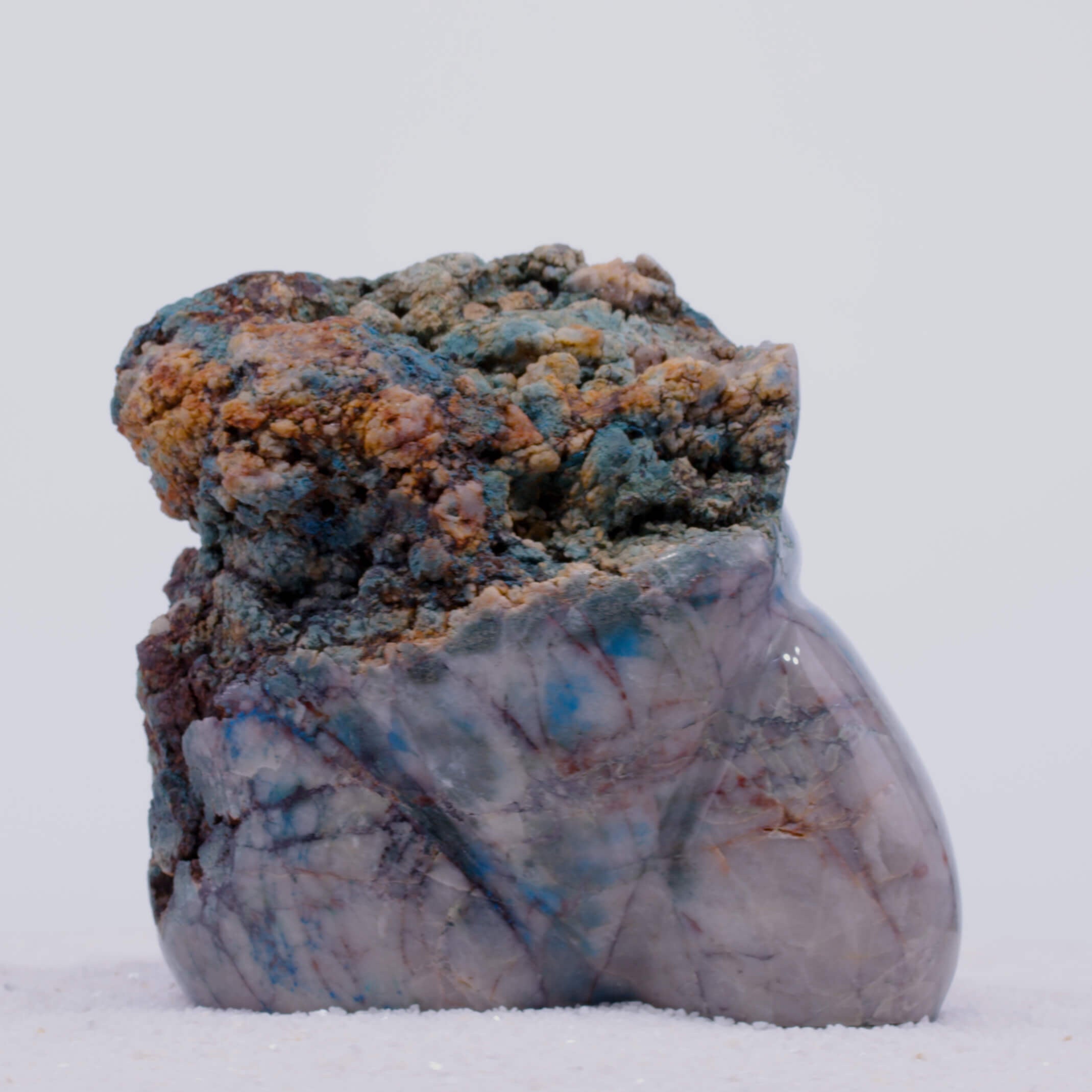
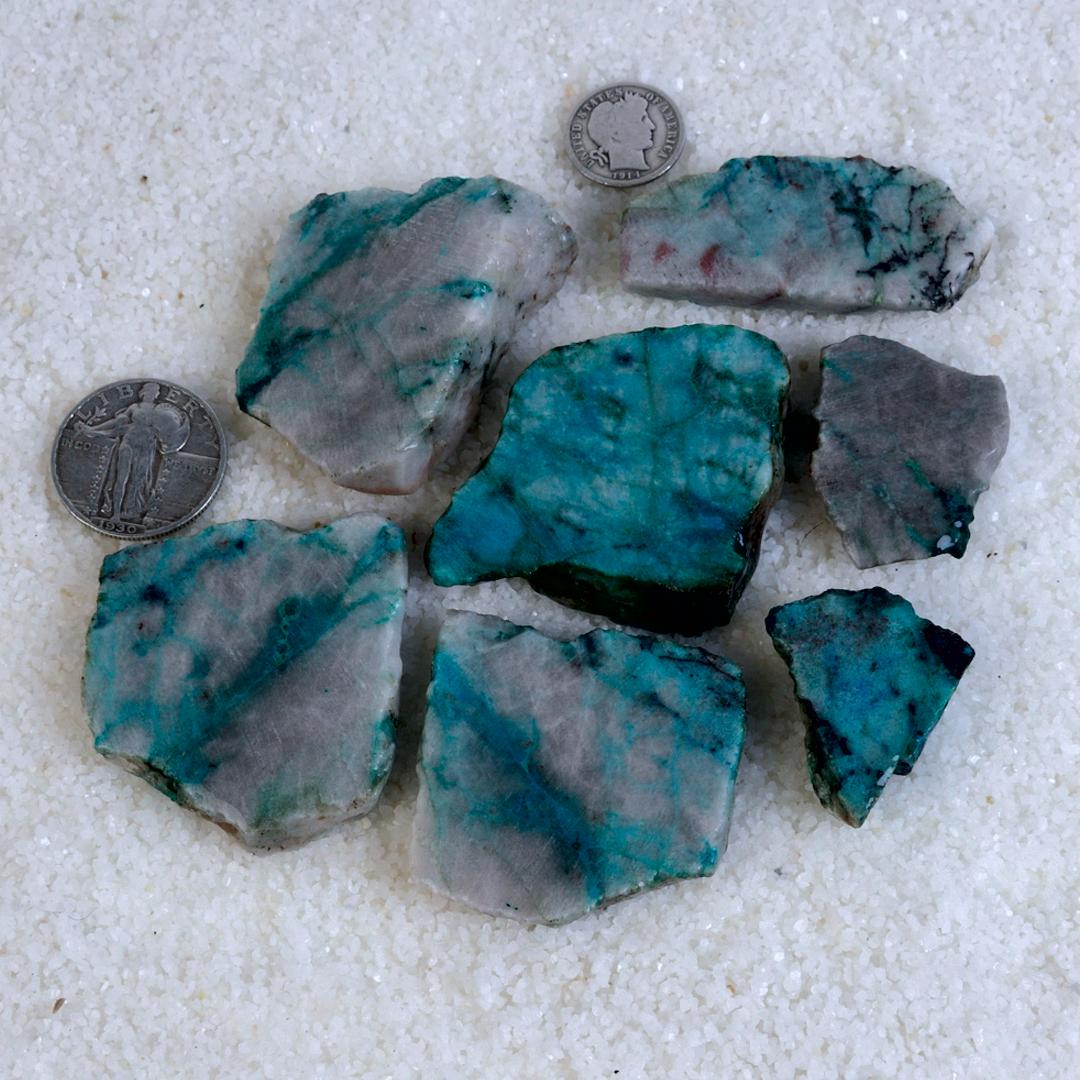
Papagoite is a mineral species; Canyonite is an assemblage material. Canyonite is the name used for a naturally occurring Southern Arizona silica-hosted material containing variable secondary copper-mineral phases preserved within chalcedony and associated silica.
Representative material has been investigated with Raman spectroscopy and complementary X-ray diffraction. The documented Raman program targeted dark-blue and light-blue mineralized areas using 532 nm and 266 nm laser work, with detailed 532 nm measurements using an 1800 grooves/mm grating and approximately 0.5 cm⁻¹ spectral resolution.
Not every Canyonite piece contains every mineral. Papagoite identified at representative analytical spots should not be extrapolated automatically to every blue region or every specimen.
Within Canyonite, translucent chalcedony and druzy silica can preserve color zoning, fractures, cavities, replacement textures and relationships among successive copper-mineral phases. This allows mineralogical relationships to remain visible after cutting and polishing.
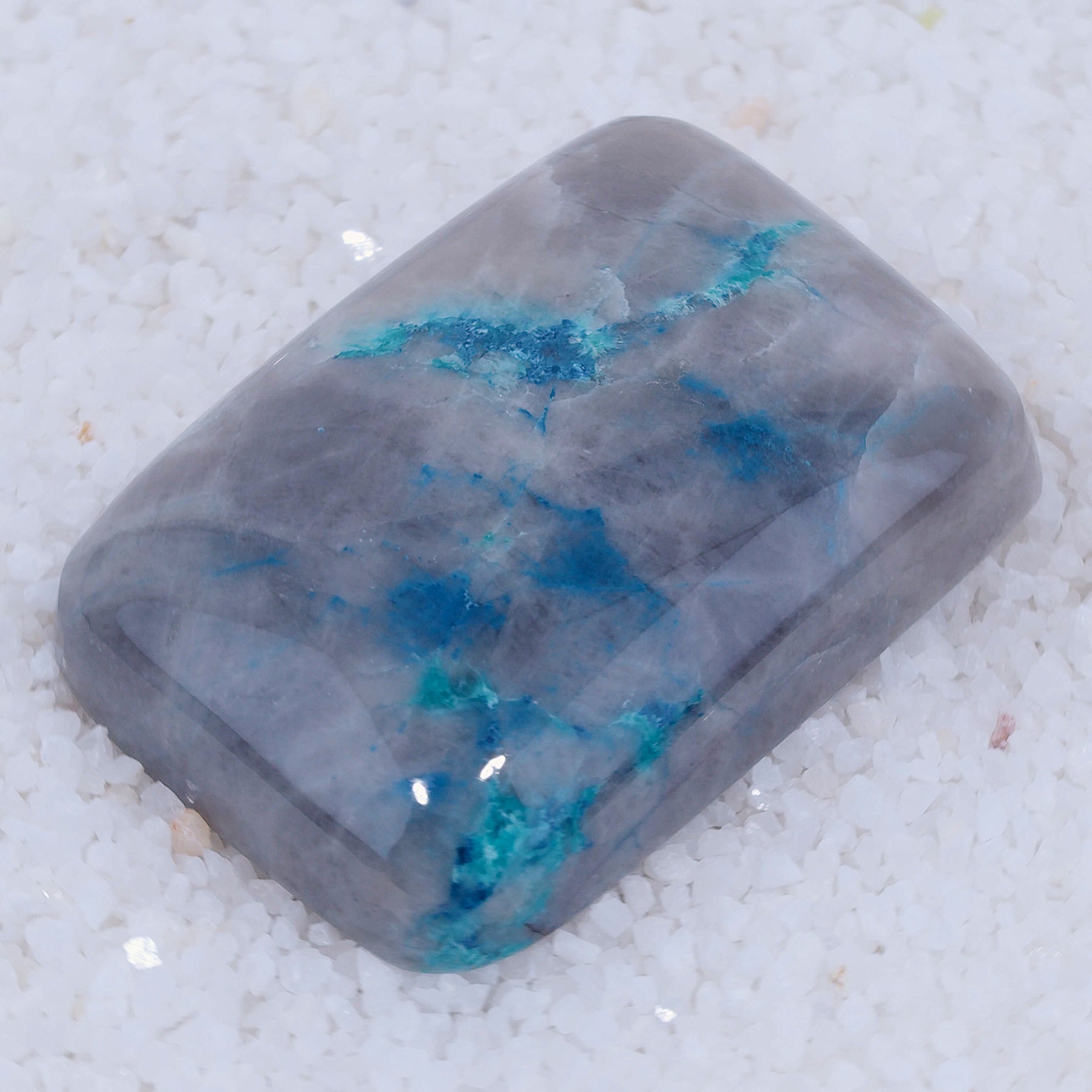
Papagoite records an unusual intersection of copper mobility, calcium, aluminum, silica, hydroxyl-bearing fluids and secondary alteration. When it survives beside Ajoite, Shattuckite, quartz or other phases, it contributes to a paragenetic record—the sequence and relationships in which minerals formed.
Modern Raman spectroscopy, micro-XRD, SEM/EDS, electron microprobe analysis and spectral mapping make these questions increasingly accessible without sacrificing entire high-value specimens.
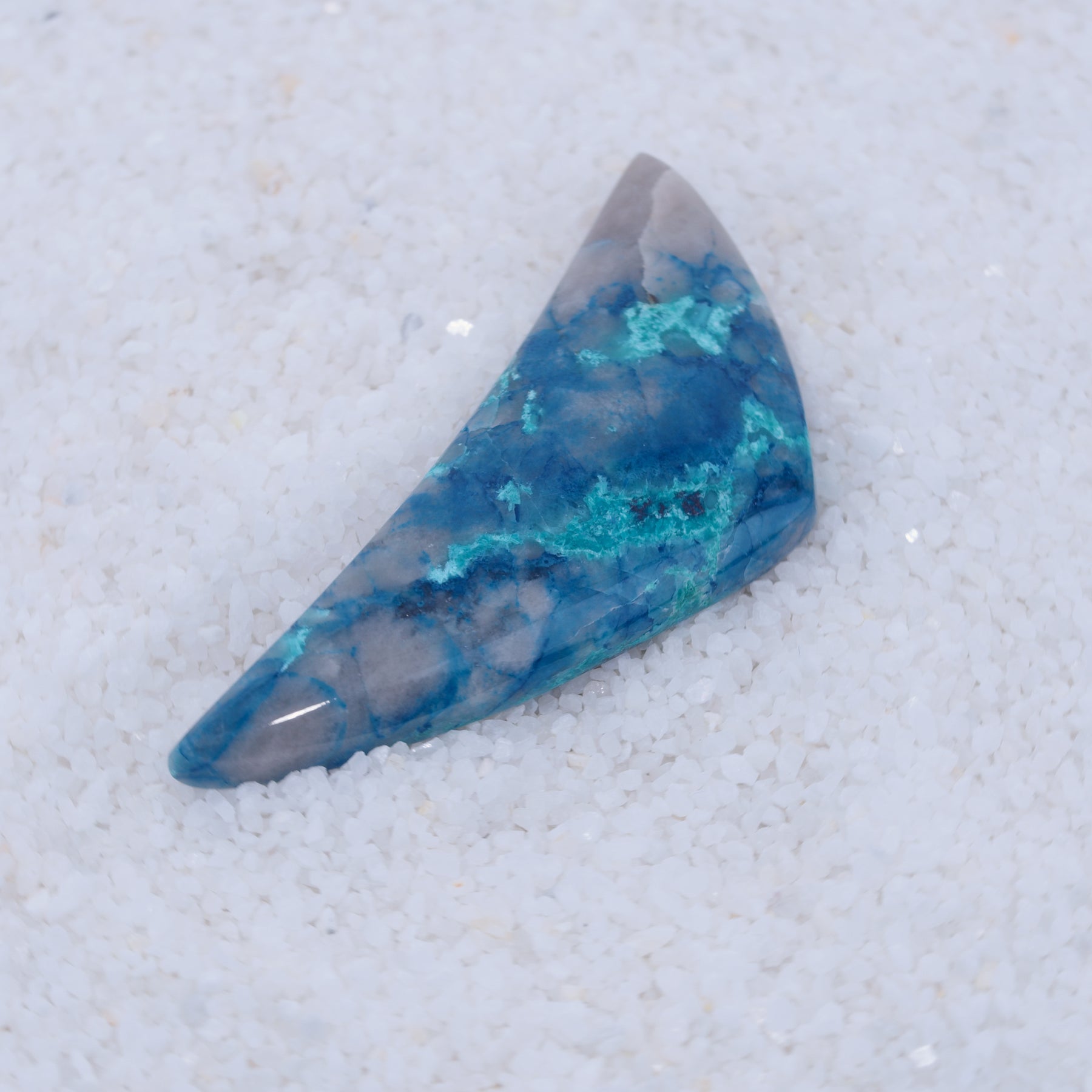
Papagoite is a rare blue calcium-copper-aluminum silicate hydroxide with ideal formula CaCuAlSi₂O₆(OH)₃. It is a monoclinic cyclosilicate formally described from Ajo, Arizona, in 1960.
Crystals can be dark blue, while massive material is commonly cerulean to lighter blue. Because many copper minerals overlap in color, blue coloration alone is not diagnostic.
The classic type locality is the New Cornelia Mine at Ajo, Arizona. Other recognized occurrences include the Messina/Musina district in South Africa, the Sinclair Mine in Namibia and the Bankov area in Slovakia.
No. Papagoite and Ajoite are distinct mineral species with different chemistry and crystal structures. They can occur together and can be difficult to distinguish visually.
Not definitively. Locality, color and texture can suggest Papagoite, but Raman spectroscopy, XRD, chemistry and microscopy provide much stronger evidence.
Yes. Papagoite inclusions in quartz from South Africa are among the species’ most famous collector occurrences.
Individual crystals are normally too small to facet, but massive Papagoite mixed with quartz and Papagoite-bearing quartz or chalcedony can be cut and polished into cabochons and collector gems.
IGS reports no known synthetic or lab-created Papagoite in the gem trade.
Delicate microcrystalline specimens should be cleaned gently with a soft brush, mild detergent and warm water. Avoid destructive streak testing on valuable specimens or finished gems.
Papagoite has been identified by Raman spectroscopy in select representative Canyonite material from Southern Arizona. Canyonite is heterogeneous, so Papagoite should not be assumed in every individual piece.
No. Papagoite is a formal mineral species. Canyonite is the name used for a Southern Arizona silica-hosted mineral assemblage containing variable secondary copper-mineral phases.
No established mineralogical or medical evidence demonstrates therapeutic effects from Papagoite. Its significance is geological, mineralogical, gemological, historical, scientific and aesthetic.
Research note: Peer-reviewed and mineralogical sources are prioritized over commercial summaries. This page distinguishes established Papagoite mineralogy from ongoing analytical interpretation of Papagoite-bearing Canyonite material.
Last reviewed: August 2026.
CrystalSleuth results showing background corrected Raman spectra from the 20 s analysis of LB-005 spot 1 shown in black, overlapping with spectra for shattuckite (blue), and papagoite (green), Red arrow shows peak associated with papagoite, which is present.
Raman Test Date: 06/13/2025
Method:
Raman spectroscopy is a non-destructive method that uses the interaction of light with molecular vibrations within a solid material or a liquid or gaseous fluid. It can provide detailed information about chemical structure, composition, crystallinity and molecular interactions, thus finding broad applications in geologic, life, pharmaceutical and material sciences. Here we used a 532 nm Nd-YAG laser and a grating of 1800 grooves/mm with a spectral resolution of ~0.5 cm-1. The instrument was calibrated using the Horiba SP-RCO inline calibration standard.
References:
Chemical Composition
Canyonite consists of a silica-dominated matrix (SiO₂) hosting a variable assemblage of secondary copper minerals formed under oxidation-zone conditions. Copper-bearing phases may include silicates, sulfates, oxides, and carbonates, with representative minerals such as papagoite, ajoite, shattuckite, chrysocolla-type material, brochantite, and related phases occurring within the chalcedony framework.
Minor elemental components — including iron, aluminum, and accessory trace elements — influence mineral stability, color variation, and local geochemical conditions during formation. Because Canyonite represents an assemblage rather than a single mineral species, overall chemical composition varies between specimens according to mineral distribution and textural relationships within the silica host.



Stay up to date with our latest releases by signing up for our newsletter.
Web Design by Coalesce Marketing & Design, Inc.