

Article: The Microscopic World Within Canyonite
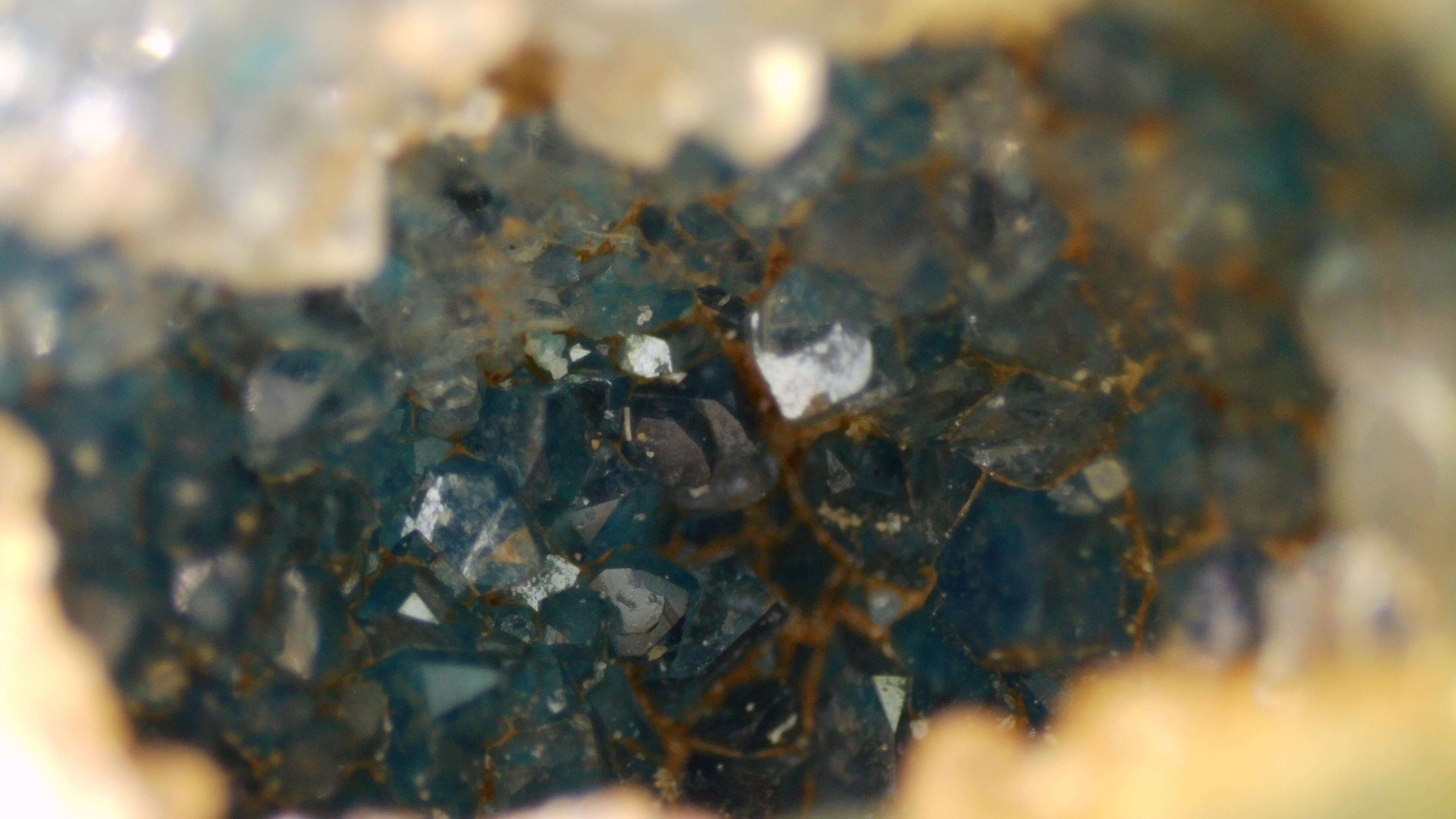
The Microscopic World Within Canyonite
To the naked eye, a gemstone reveals color and light. Under magnification, it reveals structure, sequence, and history. Microscopic examination allows scientists and gemologists to observe textures, inclusions, and growth relationships that record how a material formed over time.
Within this scale, mineral surfaces, fluid pathways, and silica frameworks become visible. What appears uniform at first glance often contains layered evidence of mineralization, enclosure, and stabilization — a geological narrative preserved within the finished stone.
Inclusions: Records of Formation
Inclusions are not flaws but documentation. Mineral fragments, fluid pockets, and textural boundaries preserve snapshots of environmental conditions during formation. These features help interpret fluid chemistry, mineral sequence, and the timing of growth events.
In Canyonite, copper-bearing minerals preserved within chalcedony frequently appear as radiating structures, diffuse color zones, and localized crystal growth surfaces. Their distribution reflects evolving chemical conditions rather than decorative patterning, making each specimen distinct in both appearance and geological context.
Structure and Geometry
At microscopic scale, crystal structure emerges through repeating atomic arrangements and fibrous mineral organization. In chalcedony, interlocking microcrystalline quartz creates a framework capable of both hosting mineral growth and preserving it.
Under polarized light and magnification, subtle variations in grain orientation, silica density, and inclusion boundaries become visible. These patterns reflect nucleation, diffusion, and enclosure processes that govern mineral formation, translating physical rules into visual structure.
A Visible Geological Record
Microscopy does more than reveal detail — it reveals sequence. Growth boundaries, replacement textures, and mineral relationships provide evidence of changing environmental conditions across time.
For Canyonite, this includes observation of copper mineralization occurring alongside silica deposition, allowing textures normally confined to thin sections to be seen at specimen scale. The result is a material that functions simultaneously as gemstone and geological archive.
Why Scale Matters
Closer observation changes interpretation. Features that appear decorative at macroscopic scale often represent process when examined more closely. Microscopic study highlights how variation, asymmetry, and texture reflect natural formation rather than deviation from perfection.
Canyonite illustrates this principle clearly. Each specimen offers an opportunity to observe how mineral growth, enclosure, and stabilization interact within silica-rich environments, demonstrating how complexity can remain preserved within finished material.

Written by Canyonite Laboratory