
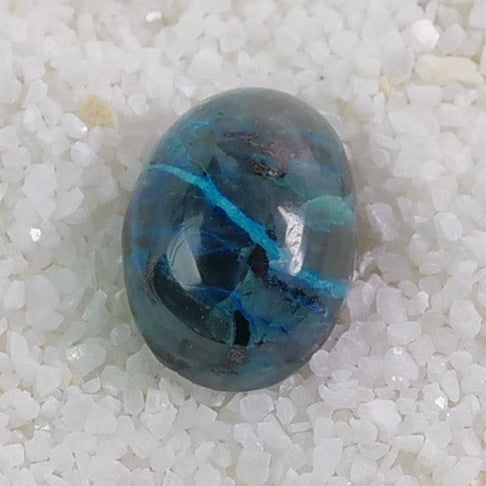
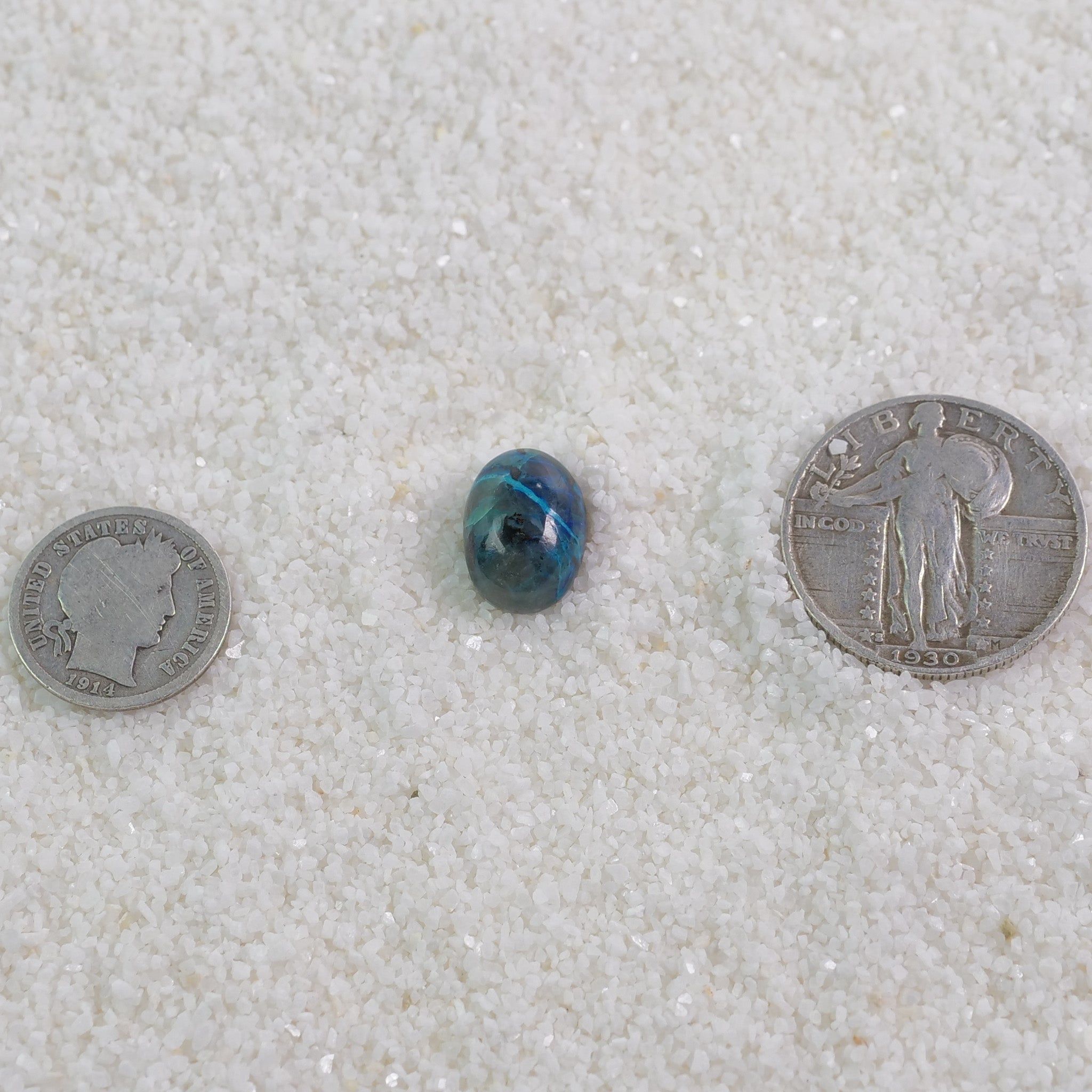
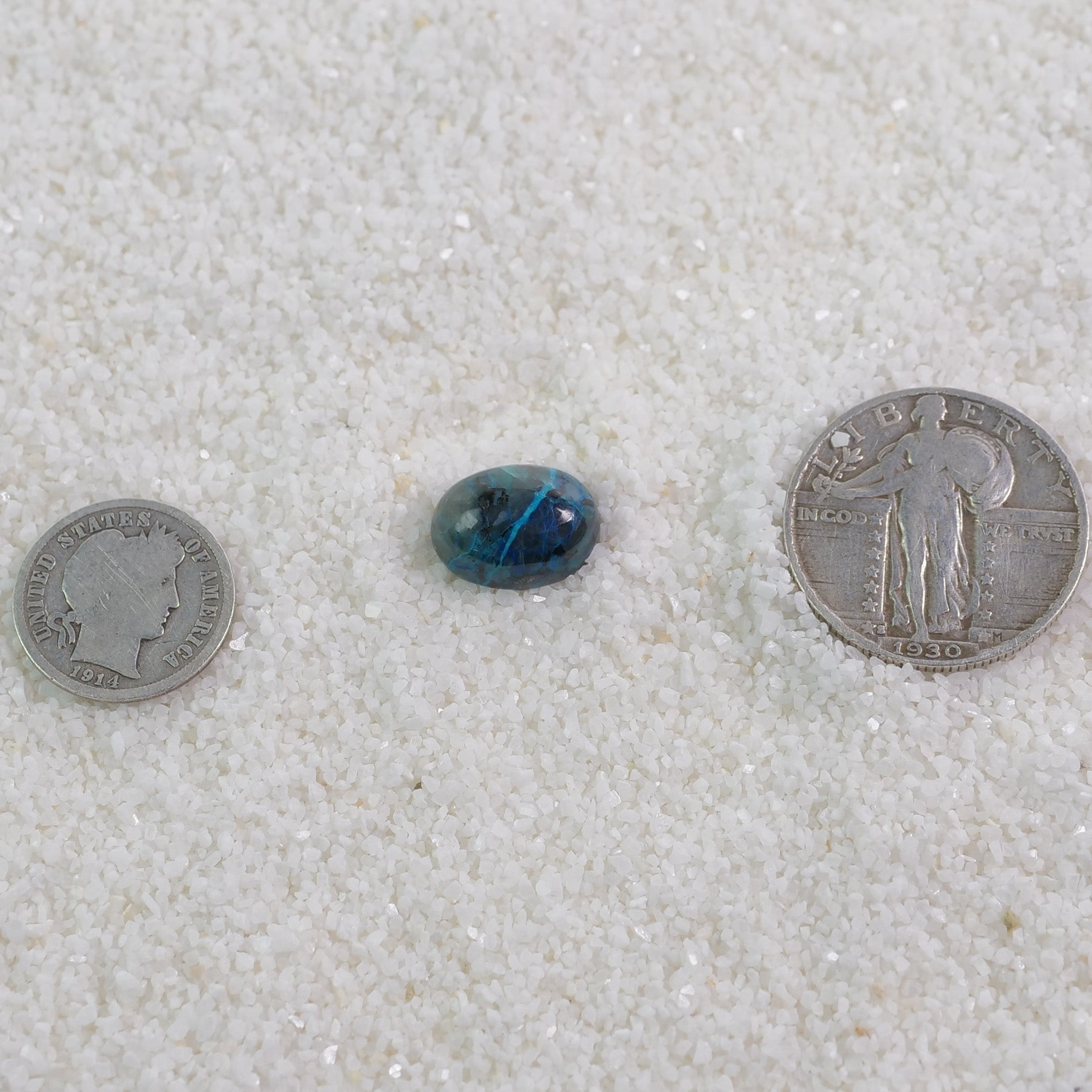
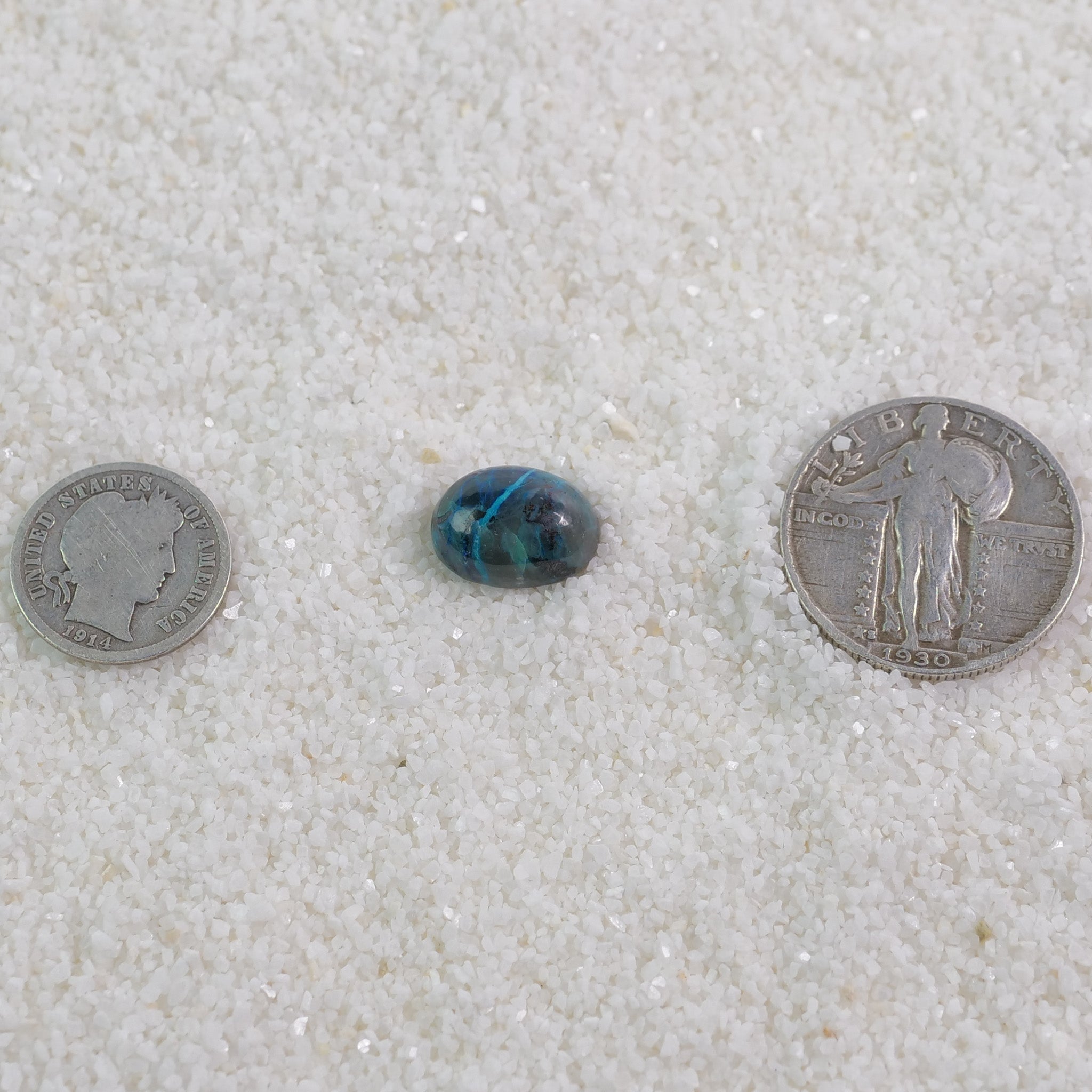
Canyonite 6.5ct Papagoite + Shattuckite Brochantite Gemstone — CS5
Presented in its natural, pure, sovereign state, and hand finished specifically for bench jewelers, this stunning gemstone features a natural crystal chalcedony vault that reveals a complex, vivid, multi-layered, silicate landscape of Chrysocolla, Papagoite and Crystalline Copper. Canyonite gemstones offer jewelry designers a highly saturated, contrasting centerpiece that brings immediate narrative and unmatched visual depth to high-end custom metalwork
Canyonite gemstones are Raman Spectroscopy Verified ensuring accurate mineral identification, scientific integrity, and represent one of the rarest lapidary materials ever documented. It's more than an embellishment—it is an investment-grade, geological anomaly that elevates jewelry lines to fine art.
Extensive comparisons against global mineralogical references, including Mindat.org, RRUFF, and other academic collections, reveal no documented parallel material exhibiting this exact mineral and matrix assemblage.
• One-of-a-kind and permanently finite
• Single-Deposit Provenance-This material comes from a non-repeatable discovery. Once exhausted, no additional material of this type is expected.
Choose options
Canyonite Sky Laboratory Point System
| Attribute | Description | Scoring Range |
|---|---|---|
| Mineral Inclusions | Density, definition, and quality of copper-silicate inclusions (Papagoite, Ajoite, Shattuckite, Chrysocolla, etc.) | 0–10 points |
| Color in Inclusions | Hue strength, saturation, and contrast of blue, teal, or sky tones within inclusion zones under full-spectrum light. | 0–10 points |
| Translucency | Degree of light transmission and internal illumination through the chalcedony matrix. | 0–10 points |
Scoring and Grade Assignment
| Grade | Total Points | Quality Classification | Description |
|---|---|---|---|
| CS5 | 27–30 | Museum Grade | Exceptional inclusions, vivid celestial coloration, and luminous translucency. Near-perfect matrix harmony. |
| CS4 | 23–26 | Collector Grade | Strong inclusions, vibrant color saturation, balanced translucency, and excellent structural coherence. |
| CS3 | 18–22 | Gem Grade | Visible inclusions, moderate color intensity, sub-translucent glow; minor irregularities accepted. |
| CS2 | 13–17 | Holistic Grade | Soft inclusions, muted sky coloration, limited translucency; grounding and stable. |
| CS1 | 0–12 | Foundational Grade | Minimal inclusions or color; fully opaque; raw elemental matrix suitable for study or lapidary work. |
Attribute Breakdown
1. Mineral Inclusions (0–10 pts)
| Score | Criteria |
|---|---|
| 9–10 | Abundant, sharply defined, rare mineral inclusions |
| 7–8 | Strong inclusions, well-dispersed with visible copper-silicate structures |
| 5–6 | Moderate inclusions, partial visibility under magnification |
| 3–4 | Sparse inclusions, faint presence of copper minerals |
| 0–2 | Indistinct, minimal inclusions or matrix dominant |
2. Color in Inclusions (0–10 pts)
| Score | Criteria |
|---|---|
| 9–10 | Exceptional vibrancy — vivid electric blues or teals with high contrast |
| 7–8 | Strong color intensity, distinct hue with balanced tone |
| 5–6 | Moderate saturation, balanced but less vivid |
| 3–4 | Faint or patchy coloration, low contrast |
| 0–2 | Minimal or absent color expression |
3. Translucency (0–10 pts)
| Score | Criteria |
|---|---|
| 9–10 | Superior translucency to semi-transparency; radiant internal illumination |
| 7–8 | Moderate translucency; soft internal glow |
| 5–6 | Sub-translucent; partial light penetration visible in zones |
| 3–4 | Mostly opaque; limited translucency near edges |
| 0–2 | Fully opaque; no internal light transmission |
Canyonite mineral inclusions are confirmed through Raman and XRD analyses to verify mineral identity and structural phases wherever inclusion analysis is possible.

Stay up to date with our latest releases by signing up for our newsletter.
Web Design by Coalesce Marketing & Design, Inc.